Forest App Alternative: For the Other 14 Hours
Disclosure: Cursed Screen is our product. Forest data from their Play Store listing and website. Last reviewed: April 2026.
Forest is one of the most loved focus apps ever shipped. 10M+ downloads. Plant a virtual tree, focus for 25 minutes, the tree grows. Walk away from the app and the tree dies — a little sapling killed by your impulse to check Instagram. Earn enough coins and the team plants a real tree through Trees for the Future. Over 5 million planted to date.
If Forest works for you, keep using it. You’re not reading this because Forest solved your problem. You’re reading it because you started a timer, killed three trees this week, and your evening still ended in two hours of TikTok.
What Forest does well
Forest earned its 10M+ downloads honestly. The mechanics are clever, the design is beautiful, and the eco-angle gives the gamification real weight.
- Emotional attachment to the tree. Killing a digital sapling feels worse than dismissing a timer notification. That’s good design.
- Real trees get planted. Coins convert into real-world impact through Trees for the Future. Not a gimmick — a tangible result.
- Plant Together mode. Friends start a session and everyone’s trees live or die together. Social accountability without judgment.
- Cheap on iOS, free on Android. $3.99 one-time on iOS, free with ads on Android. Hard to beat on price.
- The forest you build is satisfying. Watching weeks of focus stack into a small private woodland feels good.
For students doing structured study blocks, or remote workers who can compartmentalize focus into 25-minute Pomodoro chunks, Forest is probably the right tool.
Where Forest breaks
The problem isn’t Forest. The problem is what Forest is built to do.
Forest works during active timer sessions you start manually. That’s the entire scope. You decide to focus, you tap the button, the tree grows. Outside that window, the app does nothing. The 25-minute focus session works. The three-hour evening scroll that follows it doesn’t show up in the app at all.
If your phone problem is “I can’t keep my hands off Reels at 11pm,” Forest isn’t built for that moment. There’s no tree to kill — you never started a session. You’re in default mode, which fills 90% of the day.
- Timer-only intervention. Between sessions, the app is dormant. It can’t help with the scrolling you do at red lights, in line for coffee, or in bed.
- Phone lock is all-or-nothing. Can’t selectively allow work apps while blocking social media.
- No automatic Pomodoro cycles. Manual restart between work and break interrupts flow.
- Android version is ad-supported. For an app meant to help you ignore your phone, the irony lands hard.
- Doesn’t address the scroll. Forest answers “don’t touch the phone for 25 minutes.” It doesn’t answer “stop scrolling when you pick it back up.”
That last point is the real one. Forest treats focus as a session you opt into. Phone addiction isn’t a session — it’s a default state. Most people’s days disappear in the 14 hours of unstructured phone time around their focus blocks, not in the blocks themselves.
Forest vs Cursed Screen
| Forest | Cursed Screen | |
|---|---|---|
| Active during | Timer sessions only | All phone use |
| Between sessions | Nothing | Gets worse if you scroll |
| Rewards | Trees and coins for logged sessions | A streak for staying off |
| Blocks phone? | Yes (phone lock mode) | No (nothing blocked) |
| Platforms | Android, iOS, Chrome | Android only |
| Price | Free with ads on Android, $3.99 iOS | Free trial, then $29.99/yr or $98.99 lifetime |
How Cursed Screen is different
No timer. No session to start. The app runs in the background and watches your screen time accumulate. After a grace period you set (default 30 minutes for the day), the screen begins to change.
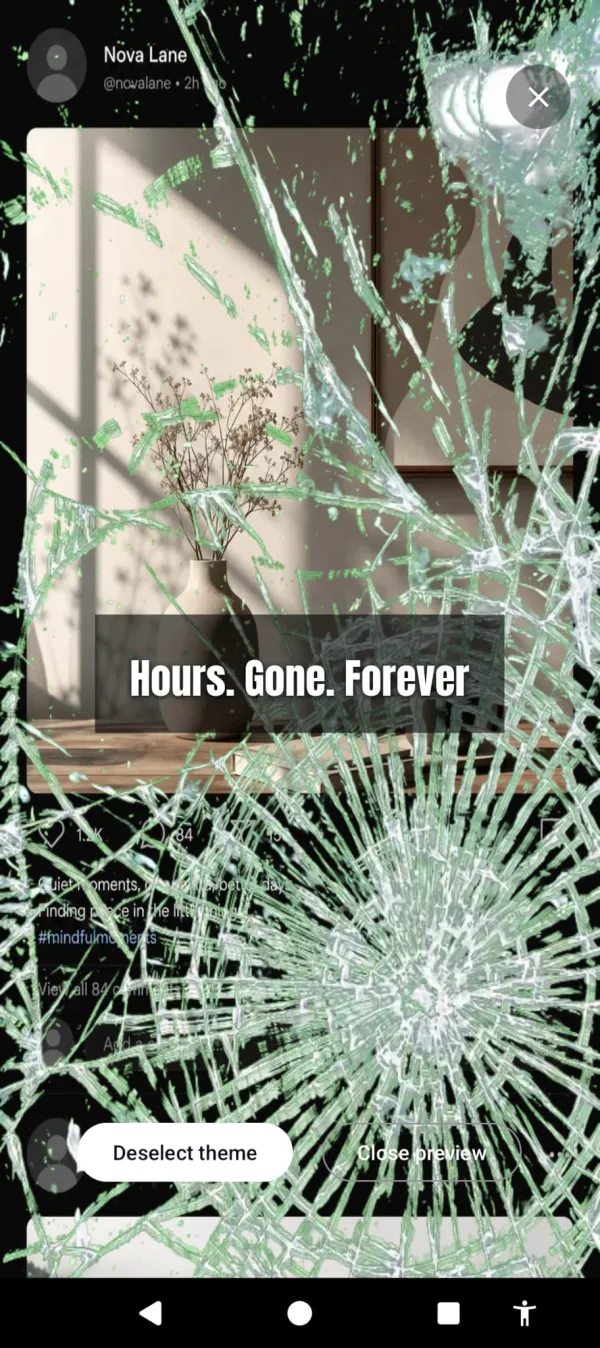
Visual overlays creep in from the edges. Flames licking up from the bottom of the display. Cracks spidering across the glass. Bugs crawling at the periphery while you scroll. The longer you stay on the phone, the worse it gets. Nothing is blocked. Every tap goes through. The phone just looks progressively wrong.
Keep scrolling and the glass gives out. Hours. Gone. Forever.
There’s also a positive mode that flips the polarity. Instead of decay, you get flashes of aurora borealis and golden sunlight at the screen edges, with text nudges like “the world misses you” or “someone is smiling nearby.” It pulls you off the phone with beauty instead of punishment. You can mix the two.
And there’s a streak — not for logging a session, but for the days you stayed under your limit. It’s the one number the app keeps, and it climbs when you put the phone down.
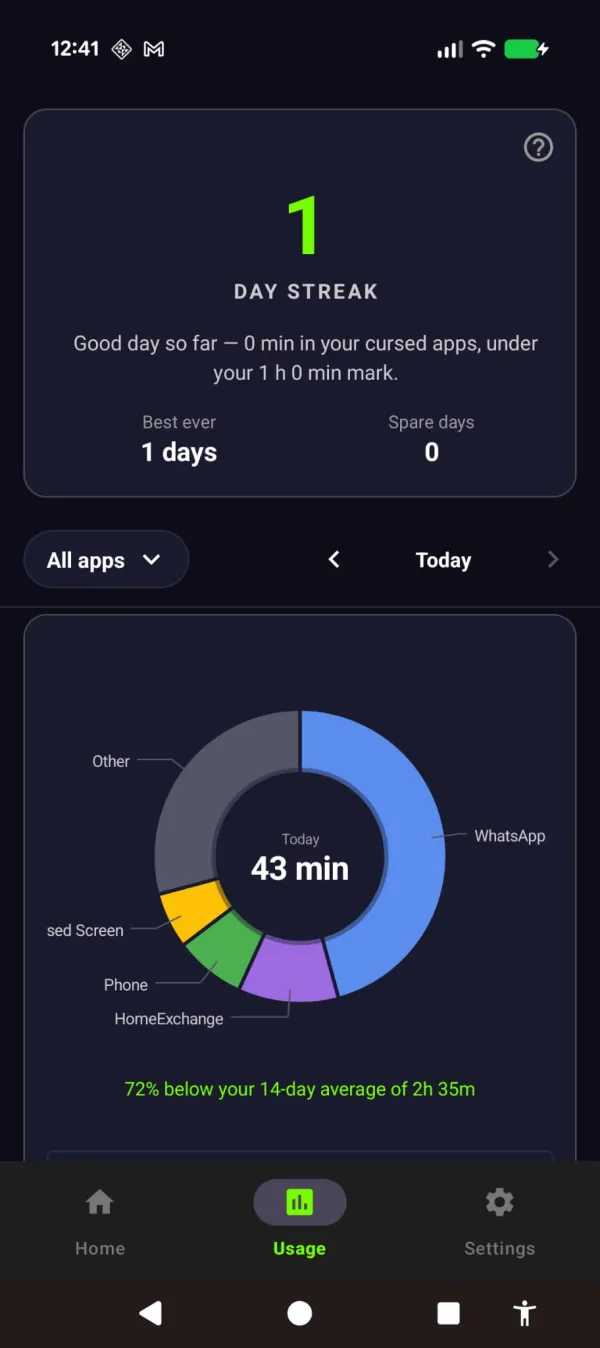
Zero minutes in your cursed apps. The streak rewards the day you skipped them.
The intervention is environmental. Not a session you remember to start. The phone changes as you use it, and you respond to the change. Over weeks, your nervous system starts associating extended scrolling with a specific unpleasant visual texture — a sensory reflex you don’t have to stay motivated to keep up. Same principle as nausea after food poisoning: your body doesn’t forget the connection.
Focus isn’t the problem. The phone is.
There’s a quieter issue with framing this as a focus problem at all, and it’s worth saying out loud.
You don’t have a focus problem. You have a phone problem. Those aren’t the same thing.
Focus apps frame the issue as “you need to be more disciplined during work.” Forest, Flipd, Opal — they’re built around the idea that you can win at attention if you set up the right system during the hours you sit down to concentrate. Plant the tree. Earn the streak. Hit the goal. That’s genuinely useful when you’re at your desk.
But it only reaches the hours you scheduled. The phone grabs you in the gaps — bed, bus stop, the walk to the kitchen — where no session is running. A tool you have to start can’t touch those moments, no matter how good it is. See how to break phone addiction for why what runs in those unscheduled hours matters most.
The reframe is simple. You don’t need to win at focus. You need the phone to stop pulling you — in the unscheduled hours, not just the study blocks.
When Forest is the right tool
Forest works for specific use cases. A student in an exam period doing 4-hour structured study days gets a real reason to stay seated when motivation dips at minute 14. If you respond to streaks — if watching a number climb day after day pulls you forward — the gamified frame works for you, and there’s no reason to abandon it.
Forest also pairs with other approaches. Use it for active study, use something else for the unstructured hours around it.
When you probably need something else
If any of these sound like you, Forest isn’t going to solve the underlying problem:
- You scroll in bed before sleep, even though you swore you wouldn’t tonight.
- You pick up the phone between meetings without deciding to.
- Your focus sessions go fine. The rest of the day is where the time goes.
- You’ve tried Forest for months and the trees stopped mattering.
- You have ADHD and structured timers don’t survive contact with your actual day. (More on that in how to focus with ADHD.)
- You’ve cycled through ten focus apps and the new one always works for two weeks.
These aren’t focus failures. They’re phone-pull failures. The phone is built to grab you in unscheduled moments, and a session-based tool can’t intervene in moments you didn’t schedule. You need something already running when the urge hits.
This is closer to the digital minimalism angle than the productivity-stack angle. More friction with the device itself, working in the background instead of only when you tap start — which is the part most screen time apps miss.
Closing thought
Forest gave 10 million people a reason to put their phone down for 25 minutes at a time. That’s a real win. If gamification is the language your brain speaks, plant the trees.
But if you’ve already tried that and your phone addiction is still there at 11pm, hiding in the gaps between focus sessions, you need a tool that doesn’t ask you to start anything.
Cursed Screen is Android-only, free trial included, then $29.99/year or a $98.99 lifetime unlock. No accounts. No personal data collected. The one number it keeps — your streak — climbs when you put the phone down. Your virtual forest is beautiful. Your phone’s screen after 90 minutes of TikTok should not be.
Ready to try a different approach?
Cursed Screen makes your phone progressively uglier the longer you use it. No blocking, no willpower needed — you'll want to put it down.
Get Cursed Screen on Google Play