How to Focus With ADHD When Your Phone Won't Let You
You sat down to work 20 minutes ago. You’ve checked your phone 11 times. Not because you got a notification. Because your brain needed something. A hit of novelty. A quick stimulus. Anything to break the monotony of the task in front of you. The task isn’t hard. Your brain just won’t let you do it without interruption.
If you have ADHD, your phone isn’t just a distraction. It’s the most efficient dopamine delivery system ever built, plugged directly into the neurology that makes ADHD hard in the first place. That’s why phone addiction hits ADHD brains harder — same hook, deeper well.
Why ADHD and phones are a uniquely bad combination
ADHD brains have lower baseline dopamine activity. That’s not a simplification; it’s the core neurological difference. The dopamine system that governs motivation, attention, and reward-seeking operates at a deficit. Your brain constantly seeks stimulation to compensate. Before smartphones, that meant fidgeting, daydreaming, talking too much, starting projects without finishing them.
Now it means your phone.
Short-form video delivers a new dopamine hit every 15-30 seconds. For a brain that’s starving for stimulation, that’s not a distraction. It’s a feast. The ADHD brain doesn’t just enjoy the scroll more than a neurotypical brain. It needs it more. The phone fills a neurological gap that nothing in your work environment can match.
A 2024 cross-sectional study confirmed what you already know: students with smartphone addiction are more likely to show ADHD symptoms, and ADHD traits are consistently identified as risk factors for smartphone overuse. It’s bidirectional. ADHD makes you more vulnerable to phone addiction. Phone addiction worsens ADHD symptoms. The loop feeds itself.
Impulsivity is the strongest mediator in the relationship between screen time and ADHD symptoms. It’s not inattention that drives the phone use. It’s the impulse to pick it up — the split-second grab before your conscious brain can intervene. By the time you think “I shouldn’t be on my phone,” you’re already three Reels deep.
Why the standard advice doesn’t work for ADHD
Most screen time advice assumes a neurotypical brain. “Set a timer and stick to it.” “Use willpower to resist checking your phone.” “Replace scrolling with a healthier habit.”
This advice fails for everyone. It fails harder for ADHD.
Timers and limits assume executive function is available. Executive function — the ability to plan, prioritize, and inhibit impulses — is exactly what ADHD impairs. Asking someone with ADHD to override a screen time limit using executive function is like asking someone with a broken leg to walk it off. The tool you’re asking them to use is the tool that’s broken.
Blocking apps creates a barrier to fight. ADHD brains are oppositional to external control. Not out of spite. Out of neurology. When you block an app, the ADHD brain fixates on the blocked thing. It becomes a puzzle to solve. Finding a workaround is more stimulating than the work you’re supposed to be doing. The block makes the prohibited app more interesting, not less. This is why most of the app blockers on Android get uninstalled within a month for ADHD users — the puzzle is the reward.
“Replace with a healthier habit” assumes the healthy habit can compete. A book can’t match TikTok’s stimulus frequency. A walk can’t match Instagram’s variable-ratio rewards. For a neurotypical brain, the gap is annoying. For an ADHD brain, the gap is physiological. The healthier habit doesn’t register as rewarding because the dopamine bar has been set by 300 daily short-form videos.
A narrative review of 147 studies from January 2018 to December 2024 confirmed that excessive screen time is consistently associated with worsening ADHD symptoms, particularly inattention and hyperactivity. Sleep disruption and altered reward processing mediate the relationship. More screen time leads to worse ADHD. Worse ADHD leads to more screen time. Breaking the cycle requires something that doesn’t rely on the cognitive resources ADHD depletes.
What actually works for ADHD phone addiction
Body doubling. Working alongside someone else — in person or virtually — provides external accountability without external control. Your brain borrows focus from the social context. The phone stays in your pocket because someone else is present. Body doubling apps (880 monthly searches) pair you with virtual co-workers for exactly this purpose.
Environment restructuring. Put the phone in a different room during focus time. Not on the desk face down. Not in your pocket. In a drawer, in another room, behind a physical barrier. The impulse to check is instant and subconscious. If the phone isn’t within reach, the impulse fires and fizzles because there’s nothing to grab. By the time you could walk to the other room, the impulse has passed.
Medication. ADHD medication (stimulants like Adderall or Vyvanse, non-stimulants like Strattera) increases baseline dopamine activity. When the dopamine deficit is addressed pharmacologically, the phone’s pull weakens because your brain isn’t as desperate for stimulation. This is a conversation with your doctor, not an app recommendation. But it’s the most effective intervention for the underlying condition that makes phones so addictive to ADHD brains. A weekend dopamine detox won’t substitute — you can’t starve a deficit into balance.
Friction apps — but the right kind. One Sec works better for ADHD than hard blockers because it doesn’t create a barrier to fight. The breathing exercise interrupts the impulse without blocking the action. For some ADHD brains, that 5-second pause is enough to re-engage the prefrontal cortex. For others, the breathing exercise becomes another thing to rush through. ScreenZen is free and worth trying.
Visual deterrence — matched to ADHD neurology. Cursed Screen works differently from blockers and friction apps in a way that’s specifically relevant for ADHD.
It doesn’t block anything (nothing to fixate on bypassing). It doesn’t add a pre-opening pause (which ADHD brains rush through). Instead, it makes the phone progressively ugly while you’re using it. flames, crawling insects, glass fracturing at the edges. The visual change doesn’t require executive function to notice. It registers automatically because it’s sensory, not cognitive.
ADHD brains process sensory input differently than cognitive commands. “You should stop scrolling” is a cognitive command that requires executive function to act on. A screen covered in crawling bugs is a sensory signal that triggers an automatic avoidance response. The first requires the part of your brain that’s impaired. The second bypasses it.
Specific ADHD settings in Cursed Screen:
- Session-based tracking instead of daily. ADHD phone use comes in intense bursts, not steady all-day use. Session tracking with 3:1 decay (3 min off forgives 1 min on) matches that pattern. Short breaks between bursts reset the corruption.
- Short grace period (5 minutes). Hyperfocus can kick in within minutes of picking up the phone. A 30-minute grace period is too long; you’ll be 200 Reels deep before the overlay starts. Set it to 5 minutes so the visual consequence arrives before hyperfocus takes over.
- Intermittent flash mode. Periodic flashes of overlay between scrolling sessions interrupt the hyperfocus loop. The interruption isn’t a decision point (which requires executive function). It’s a sensory break that disrupts the flow state the algorithm creates.
- High-intensity themes (Hell, Creepy Crawlies). Subtle visual cues don’t register for ADHD brains. You need strong sensory signals. A mild red glow might not break through. Bugs on your screen will.
The long game
ADHD and phone addiction will co-exist for as long as phones deliver dopamine on demand. There is no permanent fix that doesn’t involve managing both conditions simultaneously.
If you’re not on medication and suspect ADHD, get evaluated. Medication doesn’t solve phone addiction but it reduces the neurological desperation that makes the phone irresistible.
If you are on medication and still struggling, the phone is overriding even your medicated baseline. That means the environmental and experiential interventions — body doubling, phone in another room, visual deterrence — become the next layer. Our full guide on how to break phone addiction walks through a sequenced version of this.
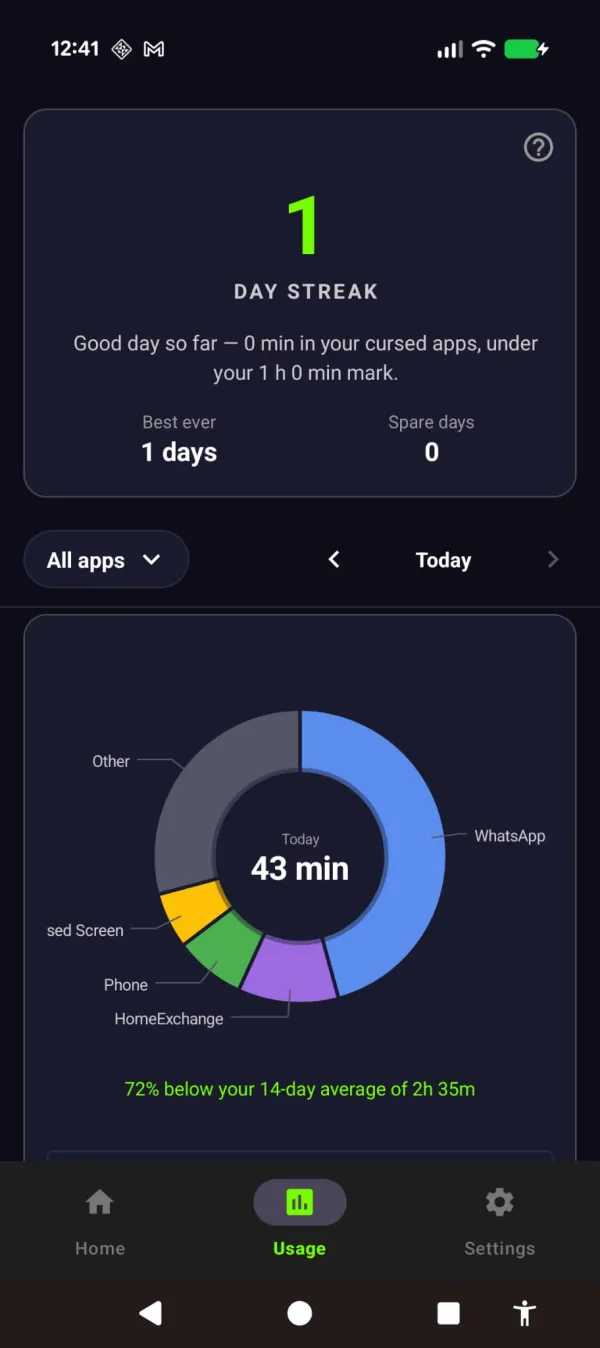
The other half of the long game: a streak that counts the days you kept it down.
Cursed Screen has a free trial on Android. Subscribe monthly or annually, or pay once for lifetime access. It won’t fix your ADHD. It’ll make the phone less capable of exploiting it.
Your brain isn’t broken. It’s wired differently. The phone was designed to exploit every brain. It just exploits yours more efficiently. Fight back with tools that match your neurology, not tools that assume you have someone else’s.
Want a tool that does this automatically?
Cursed Screen makes your phone progressively uglier the longer you use it. No blocking, no willpower needed — you'll want to put it down.
Get Cursed Screen on Google Play