Doomscrolling: What It Is and How to Stop
It’s 11:47pm. You have work tomorrow. You’re lying in bed, thumb moving on autopilot, watching a man pressure-wash a driveway. Before that it was a dog failing at agility. Before that, someone ranking fast food chicken nuggets. You don’t care about any of this. You can’t stop watching.
That’s doomscrolling. And you didn’t choose it.
What is doomscrolling?
The word started during the 2020 pandemic, when people described the compulsive habit of scrolling through bad news. Twitter feeds full of death counts and disaster. The “doom” was literal.
The meaning has evolved. Doomscrolling now describes any extended session of passive, compulsive content consumption on a phone. It doesn’t have to be bad news. It can be cooking videos, relationship drama, memes, outrage bait, or AI-generated slop. The content almost doesn’t matter. What matters is the pattern: you open the app, start swiping, and don’t stop until something external interrupts you. Your alarm. Your partner. Your bladder.
The “doom” isn’t about the content anymore. It’s about the time. The creeping realization, 40 minutes in, that you’ve been staring at your phone and have nothing to show for it. One Reddit user described the exact shape of it: “I keep saying I’ll do ‘one quick scroll’ and then it turns into hours without me noticing.”
Why is the scroll designed to be infinite?
Infinite scroll was invented by Aza Raskin in 2006. He’s since called it one of his biggest regrets. Before infinite scroll, content had pages. You had to click “Next” to see more. That click was a natural stopping point. Your brain hit a boundary and could choose to stop or continue.
Infinite scroll removed the boundary. The feed never ends. There is no bottom. Your brain never hits the signal that says “this is done” because the content is never done. TikTok, Instagram Reels, YouTube Shorts, Reddit, Twitter — all built on the same principle. Remove friction. Remove stopping points. Keep the thumb moving.
The apps reinforce this with variable-ratio reinforcement. The same schedule that makes slot machines addictive. Not every video is good. Most aren’t. But every fifth or tenth one hits. That unpredictability is the hook. If every video were equally entertaining, you’d get bored and leave. The random spikes of “that was actually funny” keep you chasing the next one.
This isn’t a conspiracy theory. It’s documented product design. Former Meta employees, former Google designers, former TikTok engineers have all described the deliberate optimization for “time spent.” The metric they optimize for is how long you stay, not whether you’re glad you did.
The algorithm also learns what keeps you specifically watching. It doesn’t just serve popular content. It builds a model of your preferences, your emotional triggers, your attention patterns. Within 30 minutes of using TikTok, the algorithm has a profile of what makes you stop swiping. That profile gets more accurate every session. You’re training it to hook you better every time you open the app.
The numbers behind the scroll
The scale of doomscrolling in 2025-2026 is staggering.
People swipe through an average of 300+ short-form videos per day across TikTok, Reels, and Shorts. That’s roughly 2.5 hours of passive video consumption at 30 seconds per clip. None of it planned. None of it chosen. Just consumed.
72% of TikTok users report watching more content than they intended. Not “slightly more.” Substantially more. The gap between “I’ll check TikTok for 5 minutes” and “I’ve been here for an hour” is the defining experience of the modern phone.
YouTube Shorts crossed 70 billion daily views in 2025. Instagram Reels make up over 50% of time spent on Instagram. The short-form video format has colonized every major platform because it works. Users watch. Advertisers pay. Platforms grow. Your attention is the currency.
210 million people worldwide are estimated to be addicted to social media. That number is going up, not down. The mechanics of social media addiction overlap with doomscrolling almost completely — same hooks, different surface area.
What does doomscrolling do to your brain?
The effects go beyond wasting time. A 2025 longitudinal study found that doomscrolling is significantly associated with higher levels of anxiety, depression, and stress. This isn’t correlation from a single snapshot. It’s tracked over time. The more you scroll, the worse you feel. The worse you feel, the more you scroll. The loop feeds itself.
The people living it describe it more honestly than any study. “Basically, I am using it to numb my feeling of emptiness,” one Reddit user admitted. The scroll stops being fun and keeps going anyway — as another put it, “I haven’t belly laughed for over 24 hours now — oh i miss you Tiktok.”
Your dopamine system recalibrates. Short-form content delivers a new reward every 15-30 seconds. Your brain adjusts to that rhythm. When you try to do something that requires sustained attention — reading, working, having a conversation — it registers as under-stimulating. Not because it’s boring. Because your baseline shifted. This is the same tolerance mechanism behind substance dependency, applied to content.
Your attention span shrinks measurably. A systematic review published in 2026 found that short video addiction impairs cognitive functioning in adolescents and young adults, specifically affecting attention, memory, and impulse control. The brain you had before TikTok processed information differently than the brain you have now. This is the slow decay people are calling brain rot, and it shows up in measurable cognitive tests, not just memes.
Your sleep gets wrecked. Each additional hour of screen time before bed raises insomnia risk by 59%, based on a study of nearly 40,000 students. You know you should stop scrolling at midnight. You stop at 2am. The blue light is part of it. The dopamine loop keeping your brain wired and searching for the next stimulus is the bigger part.
Your sense of time distorts. This is the least discussed and maybe most unsettling effect. During a doomscrolling session, your perception of time compresses. What feels like 10 minutes is actually 45. The content creates a state of low-grade flow that isn’t productive or restful. It’s liminal. Not working, not resting, not connecting. Just consuming. And when you finally put the phone down, the time doesn’t feel like it happened at all. It’s not a memory. It’s an absence. You can’t recall what you watched because none of it mattered enough to encode.
Why can’t I just stop doomscrolling?
“Put the phone down” is the most common advice and the least useful. If you could just put the phone down, you wouldn’t be reading this article.
The reason willpower fails against doomscrolling is structural, not personal. Willpower is a finite resource. It depletes throughout the day. By evening, when most doomscrolling happens, your capacity for self-regulation is at its lowest. The algorithm’s capacity is constant. It doesn’t get tired. It doesn’t have a bad day. It serves optimized content 24 hours a day, calibrated specifically to your engagement patterns. That’s phone addiction at the mechanical level — an asymmetric fight where your side runs on glucose and theirs runs on AWS.
You’re also fighting a design that removes every natural stopping point. No pages to turn. No episodes to end. No chapters to finish. The content flows continuously, and each piece is calibrated to be just interesting enough that swiping away feels like you might miss something. FOMO at the micro level, 300 times a day.
The people who successfully reduce doomscrolling don’t do it by having more willpower. They change their environment or change the experience.
Some delete the app. That works for about half the people who try it; the other 49% reinstall within weeks. Some charge the phone in a different room. That works if you don’t go get it. Some use a friction app that interrupts the autopilot. That works until the friction becomes a loading screen you stop noticing. And some change what the scrolling itself feels like so that continuing becomes uncomfortable instead of frictionless.
Breaking the scroll
If you want a complete breakdown of what works and what doesn’t, read our full guide on how to stop doomscrolling. The short version:
Friction apps like One Sec and ScreenZen interrupt the moment you open a distracting app. A breathing exercise. A countdown. A question. They reduce app opens by breaking the autopilot. They don’t do anything once you’re inside the app scrolling.
App blockers like AppBlock prevent you from opening apps entirely during scheduled times. They work until you disable them. Most people disable them.
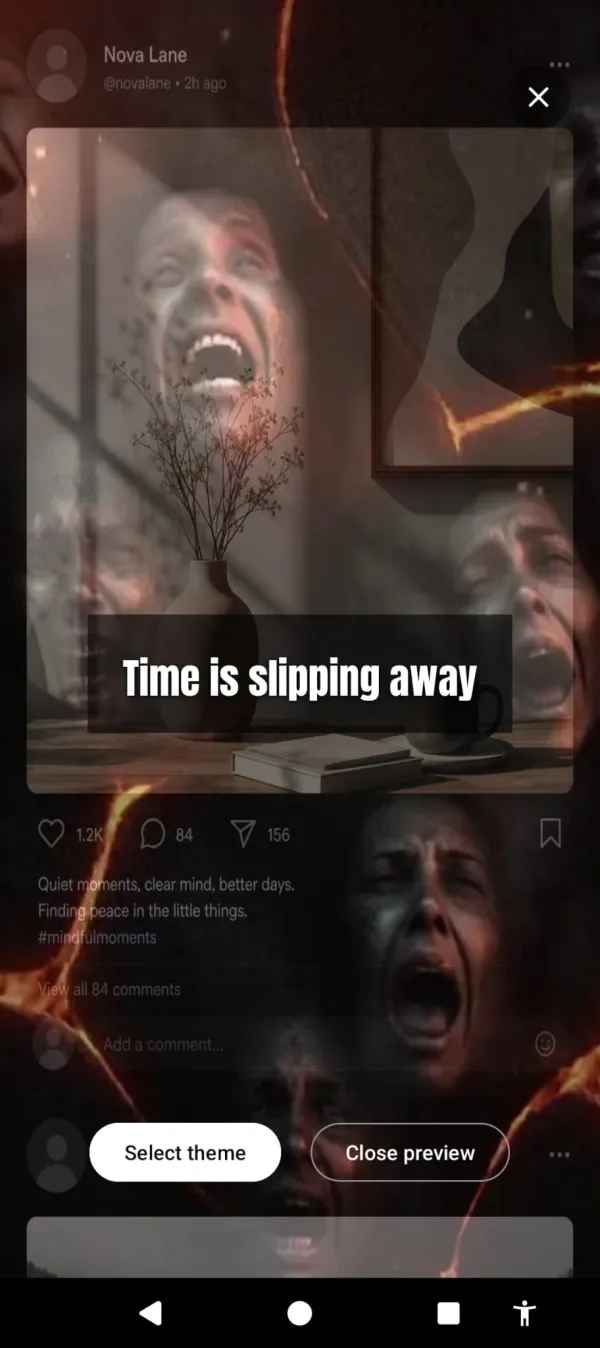
Visual deterrence is the approach behind Cursed Screen. It doesn’t block anything or ask you to pause. It makes your phone’s screen progressively ugly the longer you use it. Hellfire creeping from the edges. Glass cracking across your feed. Bugs crawling over the content. The scroll still works. The content still plays. But the experience degrades until continuing feels wrong.
Same feed, forty minutes deep. The video still plays. You just stop wanting to watch.
The key difference: it operates while you’re scrolling, not before. Friction apps guard the door. Cursed Screen changes what happens inside the room. It gets worse at minute 30 than at minute 10, worse at minute 60 than at minute 30. There’s no timer to dismiss and no block to disable. The phone just looks increasingly broken.
Dread isn’t the only lever. A positive mode flips it — aurora and golden sunlight wash the edges with a reason to look up instead of a reason to flinch — and a streak counts every day you stay under your limit. Negative, positive, or mix; you choose which one gets you off the feed.
Cursed Screen has a free trial on Android. Subscribe monthly or annually, or pay once for lifetime access.
Doomscrolling was designed. The infinite feed, the variable rewards, the absent stopping points — none of it is accidental. Fighting a designed system with raw willpower is a losing game. Something about the experience has to change. The only question is what. If you want practical tactics for the moment your thumb won’t quit, read how to stop scrolling.
Reduce your screen time — without blocking anything
Cursed Screen makes your phone progressively uglier the longer you use it. No blocking, no willpower needed — you'll want to put it down.
Get Cursed Screen on Google Play