What Is Brain Rot? The Science Behind Scrolling
Brain rot isn’t slang. Oxford named it the 2024 Word of the Year. It describes the mental decay that comes from consuming too much low-quality online content. Memes, Reels, Shorts, rage bait, reaction videos, AI slop. Hours of it, every day, until your ability to focus on anything longer than 30 seconds starts to erode. It’s the cognitive cost of doomscrolling, measured in lost attention rather than lost time.
You’ve felt it. You pick up a book and read the same paragraph three times. You start a task at work and check your phone before you finish the first sentence. Someone tells you a story and your brain is already looking for the next stimulus before they hit the point. That’s brain rot. Not a metaphor. A measurable decline in your capacity to pay attention. One Reddit user put the book part exactly: “my attention span is completely fried; I literally cannot look at a book for even a single minute.”
Does brain rot affect smart people too?
Smart people get brain rot. Doctors, engineers, writers, students with 4.0 GPAs. It has nothing to do with how sharp you are and everything to do with what you’ve trained your brain to expect.
Short-form video delivers a new stimulus every 15-30 seconds. Your dopamine system adapts to that rhythm. When you switch to something slower (a conversation, a book, a work task that takes 20 minutes of sustained focus), your brain registers it as boring. Not because it is boring. Because your baseline for stimulation has shifted.
This is the same mechanism behind drug tolerance. You need more to feel the same thing. Except the drug is content, the dose is infinite, and the dealer lives in your pocket. That’s phone addiction by the textbook definition — neurological tolerance to a stimulus you can’t easily avoid.
You can see it in yourself if you’re honest. Think about the last time you watched a 10-minute YouTube video without skipping ahead. The last time you sat through a full podcast episode without checking your phone. The last time you finished a book chapter without your thumb twitching toward Instagram. If any of those feel difficult, your baseline has already shifted. That’s brain rot doing its work.
How bad is brain rot in 2026?
The average person swipes through 300+ short-form videos per day across TikTok, Instagram Reels, and YouTube Shorts. That’s 2.5 hours of passive consumption. Not chosen. Not planned. Just… consumed.
72% of TikTok users report watching more content than they intended in a given session. YouTube Shorts hit 70 billion daily views in 2025. Instagram Reels account for over 50% of time spent on the app.
Teens aged 13-17 spend over 7 hours daily on screens outside of schoolwork. That’s more time than they spend sleeping.
A 2025 study in the Journal of Addictive Diseases found doomscrolling is significantly associated with higher levels of anxiety, depression, and stress. Another study found that short video addiction impairs cognitive functioning in adolescents and young adults, affecting attention, memory, and impulse control.
Brain rot isn’t something your parents invented to guilt you. The research backs it up.
What does brain rot do to your brain?
The effects show up in four places.
Attention span shrinks. You can’t sustain focus on a single task for more than a few minutes. Not because you’re lazy. Because your reward system has been recalibrated to expect something new every 15 seconds. A 10-minute YouTube video feels like a documentary. A chapter of a book feels like a marathon. One Reddit user described the fear that comes with it: “Scrolling constantly and now it feels like I’m developing dementia which is insane.”
Decision fatigue increases. Every scroll is a micro-decision: watch or swipe. After hundreds of those in a row, your brain’s decision-making capacity is depleted. You make worse choices about food, sleep, work, relationships. Not because you don’t care. Because the scroll burned through your cognitive budget before you got to the things that matter.
Sleep gets destroyed. Each extra hour of screen time after going to bed is tied to a 59% higher chance of insomnia symptoms, according to a study of nearly 40,000 university students. You know you should put the phone down at midnight. You put it down at 2am. The blue light is part of it. The dopamine loop is the rest.
Anxiety and depression worsen. 1 in 4 teenagers with 4+ hours of daily screen time have experienced anxiety or depression symptoms in the past two weeks. Young adults spending 5+ hours daily on their phones show a 21% higher rate of depressive symptoms than those under 2 hours. The content isn’t making you feel better. It’s making you feel nothing, which your brain interprets as needing more content. The loop tightens. This is what makes social media addiction so hard to walk away from — the apps making you feel bad are also the apps you turn to when you feel bad.
It isn’t only teenagers. “I’m 41 and completely addicted… it has wiped my memory of what life was like before,” one Reddit user wrote. “What did I even do all day? I can’t remember.” That’s the part the stats miss — not just lost attention, but lost time you can’t account for.
Why can’t I just stop scrolling?
“Just use your phone less.” Thanks.
The standard brain rot advice boils down to: set screen time limits, delete apps, go outside. All of it assumes you’ll choose the harder thing when the easier thing is sitting in your hand, serving you a perfectly optimized feed of content designed by thousands of engineers to keep you watching.
Screen time limits don’t work because only 12% of people actually use them. The other 88% set them and tap “ignore” the first time they hit the wall during a good scroll session.
Deleting apps doesn’t work because 49% of people who try a digital detox come right back. You reinstall TikTok by Wednesday. A weekend dopamine detox ends in the same rebound — restriction without recalibration just delays the binge.
Willpower doesn’t work because willpower is a finite resource and the algorithm’s resources are infinite. You run out before it does. Every single time.
What actually helps
The approaches that work share one trait: they change how using your phone feels, not just what rules you set around it.
Friction apps like One Sec and ScreenZen add a pause before you open apps. A breathing exercise. A countdown. A “do you really want to do this?” prompt. They reduce app opens by interrupting the autopilot. They don’t do anything once you’re inside the app scrolling, but they stop some sessions from starting.
Environment changes work when you commit to them. Phone in a different room at bedtime. No phone at the dinner table. Charging it in the kitchen. These create physical distance between you and the scroll. The problem is they require a decision made in advance, and they fall apart when you forget or make an exception.
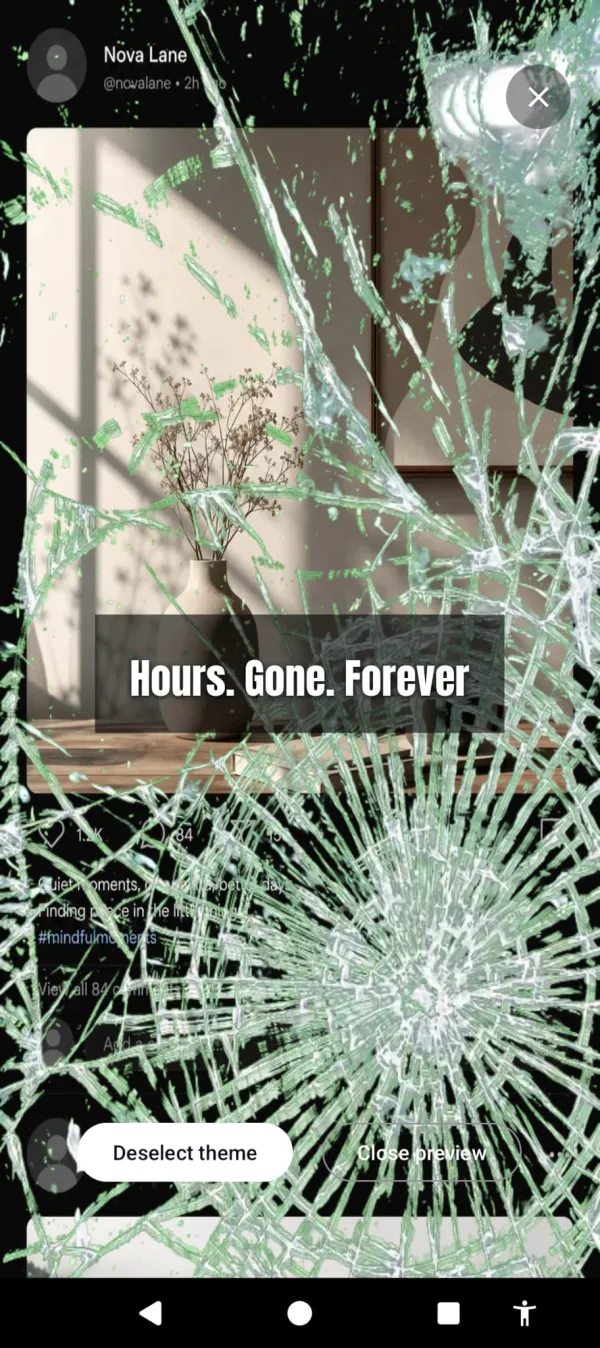
Visual deterrence is the approach I built Cursed Screen around. Instead of blocking content or adding friction at the door, it makes your phone’s screen progressively ugly the longer you use it. Hellfire creeping from the edges. Glass cracking across your display. Bugs crawling over your feed. The content is still there. You can still scroll. But the phone looks and feels wrong, and that changes your instinct to keep going.
Your feed at minute 45. The center still works. The edges are falling apart.
It works differently from the other approaches because it operates while you’re scrolling, not before you start. One Sec can’t help you 45 minutes into a TikTok session. Cursed Screen is getting worse the entire time. And unlike grayscale mode, which makes everything equally gray, the overlay targets the edges and leaves the center visible. Your phone still works. It just looks like it’s falling apart.
There’s a positive mode too, for people who respond better to a pull than a push. Flashes of aurora borealis and golden sunlight interrupt your feed with messages like “the world misses you.” Not punishment. A reminder.
It also keeps a streak. Every day you stay under your limit counts — a running tally that turns “I should scroll less” into a number you don’t want to break.
Brain rot is reversible
The damage isn’t permanent. Your attention span isn’t gone forever. When people reduce their screen time, the cognitive effects start reversing within weeks. A 2025 randomized controlled trial found that a three-week screen time reduction led to measurable improvements in well-being, depression, sleep quality, and stress.
The brain adapts in both directions. It adapted to 300 videos a day. It can adapt back. But it won’t adapt while you’re still feeding it the same diet. Something has to change about how you use your phone, and that something has to survive the moment at 11pm when you’re tired, the couch is comfortable, and the scroll is right there.
Start somewhere
Brain rot is real. The research confirms it. The platforms aren’t going to stop optimizing for engagement. If anything, they’re getting better at it. AI-generated content is flooding every feed, and the algorithms are learning faster than your attention span can recover.
But the damage reverses when you change the inputs. Three weeks of reduced screen time is enough to see measurable improvement. You don’t need to go cold turkey. You don’t need to delete your accounts. You need the scroll to stop feeling free.
You’re reading this article instead of watching your 301st Reel today. That’s a start. The question is what you do with the rest of the evening.
Cursed Screen has a free trial on Android. Subscribe monthly or annually, or pay once for lifetime access. Your phone is already rotting your brain. Now it can look like it.
Reduce your screen time — without blocking anything
Cursed Screen makes your phone progressively uglier the longer you use it. No blocking, no willpower needed — you'll want to put it down.
Get Cursed Screen on Google Play