How to Break Phone Addiction Without Blocking Apps

You’ve tried the blockers. You’ve set the timers. You’ve deleted Instagram on Sunday and reinstalled it by Tuesday. You’ve tried grayscale, tried leaving your phone in another room, tried the “just use it less” approach that works for about four hours before you’re back to scrolling at midnight. This is the standard arc of phone addiction — every fix works until it doesn’t.
1,300 people search for “how to break phone addiction” every month. Most of them have already tried the obvious solutions. If you’re one of them, this article skips the basics and gets to what actually changes the pattern.
Why the standard approaches fail
Every popular phone addiction solution relies on one of two mechanisms: removing access or adding friction. Both assume you’ll make good decisions when the mechanism fires.
Removing access (app blockers, deletion, phone in another room) works until you undo it. You always can. You installed the blocker; you can uninstall it. You deleted the app; you can reinstall it. You put the phone in the kitchen; you can walk to the kitchen. The removal is temporary and self-imposed, which means it fails exactly when the craving is strongest. As one Reddit user put it: “Regular app blockers don’t work for me — I use them for a couple days then just disable them.” Another described the muscle memory: “my thumbs would just bypass them on autopilot.”
Adding friction (screen time limits, breathing exercises, countdown timers) works until you stop noticing it. Friction apps like One Sec and ScreenZen add a 5-second pause before opening apps. That pause breaks the autopilot initially. Within weeks, the pause becomes routine. You breathe through the exercise without reconsidering. The friction becomes invisible.
Both mechanisms share a fatal flaw: they fire at a single moment (when you try to open an app) and do nothing after that moment passes. If you get past the blocker or tap through the friction, you’re on your own inside the app for as long as you want to scroll. One Reddit user named the deeper problem: “Same flaw — when you fail, nothing really happens. The app resets. There’s no actual cost to breaking your own rule.”
The missing piece: what happens during the scroll
The scroll itself is where the addiction lives. Not the moment you open the app. The 45 minutes that follow.
Every approach to phone addiction focuses on the door. Blockers lock it. Friction apps slow you down at it. Environment changes move the door further away. But once you’re through the door, nothing changes. The feed is just as infinite. The algorithm is just as optimized. The dopamine loop is just as powerful.
Breaking phone addiction requires something that works inside the scroll, not just before it. Something that makes the experience progressively worse the longer you stay, so that continuing feels like a bad idea at minute 30, not just at minute 0.
Step 1: Accept what doesn’t work for you
Be honest about your history. If you’ve tried an approach and it didn’t stick, that approach is eliminated. Not “I should try harder with it.” Eliminated. You’ve already proven it doesn’t work for your brain.
If you’ve deleted and reinstalled apps more than twice: deletion doesn’t work for you. If you’ve set screen time limits and tapped “ignore”: limits don’t work for you. If you’ve used a blocker and disabled it within a month: blocking doesn’t work for you. If you’ve done a dopamine detox and relapsed by Sunday night: cold turkey doesn’t work for you.
Each failed attempt narrows the field. That’s useful information. Stop repeating the same approach expecting different results.
Step 2: Change the experience, not the rules
Rules require enforcement. Enforcement requires willpower. Willpower is depleted by the time you’re scrolling at 11pm. This is why every rule-based approach fails after sunset. One Reddit user summed up the mismatch: “I was expecting willpower to beat algorithms designed to keep me scrolling. That wasn’t a fair fight.”
Instead of rules about when or how much you can use your phone, change what using the phone feels like. If the scroll is pleasant, you’ll continue. If the scroll becomes unpleasant, you’ll stop. Not because a rule told you to. Because the experience itself pushed you out.
Cursed Screen does this by making your phone’s screen progressively ugly the longer you use it. After a grace period, animated overlays creep in from the edges. Crawling insects. A red glow. Glass fracturing. The content is still there. Everything still works. But the visual experience degrades until continuing feels wrong.
The feed still loads. It just starts to look like what it’s doing to you.
This isn’t a rule to follow or a timer to obey. It’s a sensory change that your brain processes automatically. You don’t need executive function to notice that your screen is covered in bugs. You don’t need willpower to feel uncomfortable. The discomfort does the work.
Dread isn’t the only setting. Flip it and a positive mode does the reverse — the screen breaks into aurora and warm sunlight, nudging you toward what’s waiting off the phone instead of pushing you off it. Negative, positive, or a mix; you pick. And every day you stay under your limit builds a streak, so putting the phone down finally counts for something instead of vanishing unnoticed.
What it looks like in a real afternoon.
Step 3: Set up for your actual behavior
Configure whatever tool you choose based on how you actually use your phone, not how you wish you used it.
If you doomscroll in bed: Set a short grace period (5-10 minutes). The overlay should kick in fast at night when your willpower is lowest. For more tactics specific to that nighttime scroll, see how to stop doomscrolling.
If you lose time to social media during work: Use session-based tracking. It resets when you put the phone down, so work breaks don’t accumulate. The overlay only builds during sustained scrolling.
If you use your phone for legitimate purposes throughout the day: Whitelist apps you need (maps, banking, messaging, work tools). The overlay should target the compulsive use, not the functional use.
If you cycle between apps: Don’t use per-app blocking. Use a tool that tracks total screen time across all apps. Switching from TikTok to Instagram to YouTube should all count toward the same accumulation.
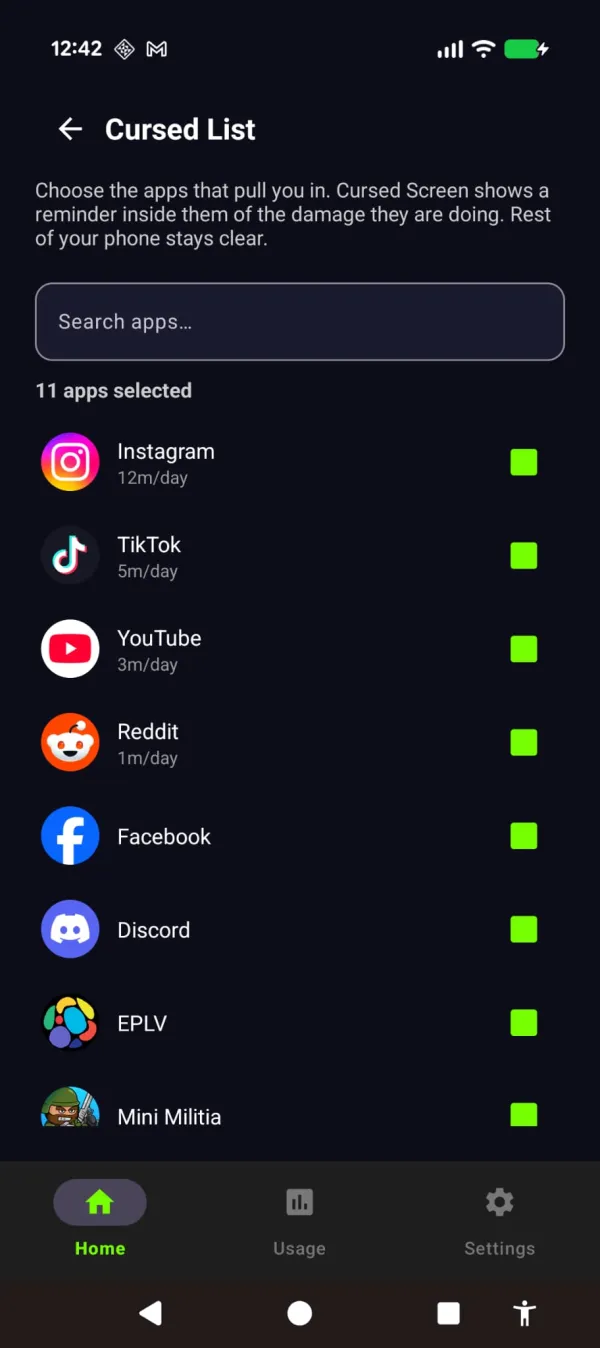
You choose which apps get cursed. The ones eating your evenings go on the list; maps and banking stay clean.
Step 4: Expect the first week to be uncomfortable
Regardless of which tool you use, the first week of reduced phone use is uncomfortable. Your brain has adapted to a stimulus frequency that the real world can’t match. Without 300 daily short-form videos, you’ll feel restless, bored, and itchy for your phone. If the absence of the phone triggers genuine anxiety, not just restlessness, that’s nomophobia — and it’s worth naming because the response is different.
That discomfort is the recalibration happening. A 2025 randomized controlled trial showed that three weeks of reduced screen time produces measurable improvements in well-being, depression, sleep quality, and stress. The improvements start within the first week. The discomfort fades within the first week. Both happen together.
Don’t interpret the discomfort as a sign that the approach isn’t working. It’s a sign that it is.
Step 5: Measure with your screen time tracker
Your phone already tracks your usage. Check it weekly, not daily. Daily checking creates anxiety. Weekly checking reveals trends.
Compare this week’s screen time average to last week’s. If total social media time is dropping, the approach is working. If it’s not, adjust settings (shorter grace period, different themes, session tracking instead of daily).
The number you’re watching isn’t total screen time. It’s unintentional screen time. The minutes that disappeared without your choosing. That’s the addiction metric.
The long version
Phone addiction breaks the same way every addiction breaks: not through a single moment of willpower, but through sustained environmental change that makes the addictive behavior less rewarding over time.
You’re not going to wake up one morning and stop wanting to scroll. The wanting is neurological. What you can do is make the scrolling less pleasant, consistently, for long enough that your brain’s reward association weakens. Three weeks, per the research. Not three days.
Cursed Screen has a free trial on Android. Subscribe monthly or annually, or pay once for lifetime access. It won’t break your phone addiction in a day. It’ll make the phone a little worse to use, every day, until the addiction loosens its grip.
You searched “how to break phone addiction.” You’ve probably searched it before. This time, try something you haven’t tried. The definition of this cycle is doing the same thing and expecting a different result.
Want a tool that does this automatically?
Cursed Screen makes your phone progressively uglier the longer you use it. No blocking, no willpower needed — you'll want to put it down.
Get Cursed Screen on Google Play