Screen Time: The Complete Guide to Reducing It
Americans spend 5 hours and 16 minutes on their phones every day. That’s a 14% increase from 2024. The average person checks their phone 142 times daily, up 12% from last year. By the time you finish reading this article, most people will have checked their phone at least once.
You probably think you’re below average. Almost everyone does. Almost everyone is wrong.
How much screen time is too much?
The global picture is staggering. Average daily screen time hit 4 hours 45 minutes globally in 2025, with some countries averaging over 5 hours. But those are averages, which means they include people who barely use their phones. If you’re reading an article about screen time, you’re probably well above the median.
By generation:
- Gen Z spends 6 hours 27 minutes per day on their phones. 76% say it’s too much.
- Millennials average around 5 hours. 67% say it’s too much.
- Gen X clocks about 4.5 hours. 66% say it’s too much.
- Boomers come in at just over 4 hours. 51% say it’s too much.
Notice the pattern. Every generation knows they’re spending too much time on their phones. Knowing doesn’t change the behavior. 53% of Americans say they want to cut down on phone usage in 2025, a 33% increase from 2023. The desire to change is growing faster than the actual change. If you’ve already searched for how to reduce screen time, you’re part of that gap.
Teenagers are in a league of their own. Teens aged 13-17 spend over 7 hours daily on screens outside of schoolwork. More time than they spend sleeping. 50% of teens identify as addicted to their phones, and 59% of their parents agree.
Where does all the screen time go?
Not all screen time is equal. Checking a map, responding to a work email, and video-calling your family are all “screen time.” So is your 90th minute on TikTok.
The problem isn’t the total number. It’s the ratio. Most people’s screen time breaks down roughly like this:
- Social media and short-form video: 2 hours 41 minutes daily (up from 2:35 in 2024). This is the passive, unplanned, dopamine-driven time. TikTok averages 89 minutes per user per day. Instagram Reels account for over 50% of time on Instagram.
- Messaging and communication: varies, but generally intentional and functional.
- Work/productivity apps: intentional screen time that’s hard to reduce.
- Entertainment (streaming, gaming): chosen consumption, different from scroll-based consumption.
- Utility (maps, banking, weather): brief, functional, not the problem.
The screen time that wrecks your focus, sleep, and mood is overwhelmingly the first category: social media and short-form video. That’s the time you didn’t plan, don’t remember choosing, and feel vaguely bad about afterwards.
Here’s a quick test. Open your phone’s screen time tracker right now (Settings > Digital Wellbeing on Android, Settings > Screen Time on iOS). Look at your social media total for yesterday. Now ask yourself: did you decide to spend that much time on those apps? Or did it just happen?
If it just happened, that’s the screen time worth cutting. The rest is fine.
What does too much screen time do to you?
The effects are documented across hundreds of studies. They cluster into four areas.
Mental health deteriorates. 1 in 4 teenagers with 4+ hours of daily screen time have experienced anxiety or depression symptoms in the past two weeks. That’s 27.1% for anxiety and 25.9% for depression, compared to 12.3% and 9.5% for those under 4 hours. Young adults using phones 5+ hours daily show a 21% higher rate of depressive symptoms than those under 2 hours. U.S. mental health clinics reported a 16% rise in phone-related anxiety cases in early 2025 vs 2024.
Sleep quality crashes. Each extra hour of screen time after going to bed raises insomnia risk by 59%. Students sleep 24 minutes less per night for every additional hour of screen use. 67% of teenagers report that late-night phone use has significantly disrupted their sleep. This isn’t just blue light. It’s the dopamine loop keeping your brain wired when it should be winding down.
Attention span erodes. This is the brain rot effect. Your brain adapts to the stimulus frequency of short-form content (new reward every 15-30 seconds). Anything slower feels boring. Books. Conversations. Work tasks that require 20 minutes of sustained focus. Your attention didn’t break. It recalibrated to a pace that the real world can’t match.
Productivity drops. U.S. employees lose 2.5 hours per workday to digital distractions unrelated to their jobs. That’s $1.3 trillion in annual productivity loss across the economy. 48% of Gen Z workers explicitly say their smartphone reduces their daily work productivity. Employees switch tasks every 47 seconds due to notifications. And it’s not just the time lost during the distraction. Research on context switching shows it takes 15-25 minutes to fully re-engage with a complex task after an interruption. If you check your phone 6 times an hour, you never reach deep focus.
Relationships suffer. 51% of people in relationships report being “phubbed” (phone-snubbed) by their partner. 71% say they spend more time on their phone than with their romantic partner. Almost half of teenagers say their parents get distracted by their phones. The screen time isn’t just stealing your time. It’s stealing your presence.
Why don’t screen time limits work?
Android has Digital Wellbeing. iOS has Screen Time. Both let you set app timers. Both are ignored by the vast majority of users.
80% of smartphone users create their own rules to limit screen time. Only 12% actively use the built-in tools. The other 68% made rules, installed nothing, and broke their own rules within a week.
The built-in limits have a fatal design flaw: they ask you to make a good decision at the worst possible moment. You’ve been scrolling for 45 minutes. Your dopamine system is fully engaged. A notification pops up: “You’ve reached your limit for Instagram.” Two buttons: “OK” and “Ignore Limit.” Which one do you tap?
You already know. Everyone taps ignore. The limit becomes a minor annoyance, not a wall. It’s a polite suggestion from your past self that your present self immediately overrides. We unpacked the full design flaw in our piece on why screen time limits keep failing — short version: the wrong intervention at the wrong moment.
What actually reduces screen time
A 2025 randomized controlled trial found that three weeks of screen time reduction led to measurable improvements in well-being, depression, sleep quality, and stress. Reducing screen time works. The question is how to make the reduction stick.
Friction apps add a pause before you open distracting apps. One Sec inserts a breathing exercise. ScreenZen shows a countdown with a mindfulness prompt. These reduce app opens by interrupting the autopilot pattern. ScreenZen is free with no ads, rated 4.7 with 25,000 reviews. They’re the best entry point if you’ve never tried anything.
App blockers like AppBlock and Freedom prevent you from opening apps entirely during scheduled times. AppBlock’s strict mode makes it genuinely hard to cheat. Freedom syncs across devices. They work for people who need a hard wall. They fail for people who disable the wall. The full landscape of apps to manage screen time covers where each one breaks down.
Environment design is the unpopular answer that works. Charge your phone in the kitchen. Buy a $10 alarm clock so the phone doesn’t need to be next to your bed. Put it in a drawer during dinner. Leave it in the car when you go to a restaurant. These reduce screen time by increasing the physical effort required to pick up the phone. You won’t walk to the kitchen for a quick scroll. You will reach to your nightstand. Environment design works because it doesn’t rely on willpower in the moment; it removes the decision entirely. This is the practical core of digital minimalism — most of the philosophy comes down to where the phone physically lives.
Visual deterrence is the approach behind Cursed Screen. Instead of blocking apps or adding friction before you open them, it makes your screen progressively ugly the longer you use your phone. Hellfire, cracking glass, creepy crawlies creeping in from the edges. Nothing is blocked. Everything still works. The phone just looks increasingly wrong, which changes the feeling of scrolling from rewarding to uncomfortable.
This works differently from the other approaches because it doesn’t rely on a decision point. Limits ask you to stop when a timer goes off. Friction asks you to reconsider when you open an app. Visual deterrence makes the phone worse while you’re using it, getting progressively more intense the longer you scroll. There’s no moment where you choose to override it, because there’s nothing to override. The overlay is just there, getting worse.
There’s a positive mode too. Flashes of northern lights and golden sunlight interrupt your scrolling with messages like “the world misses you” and “there’s magic out there.” For people who respond better to a reminder of what they’re missing than a punishment for staying.
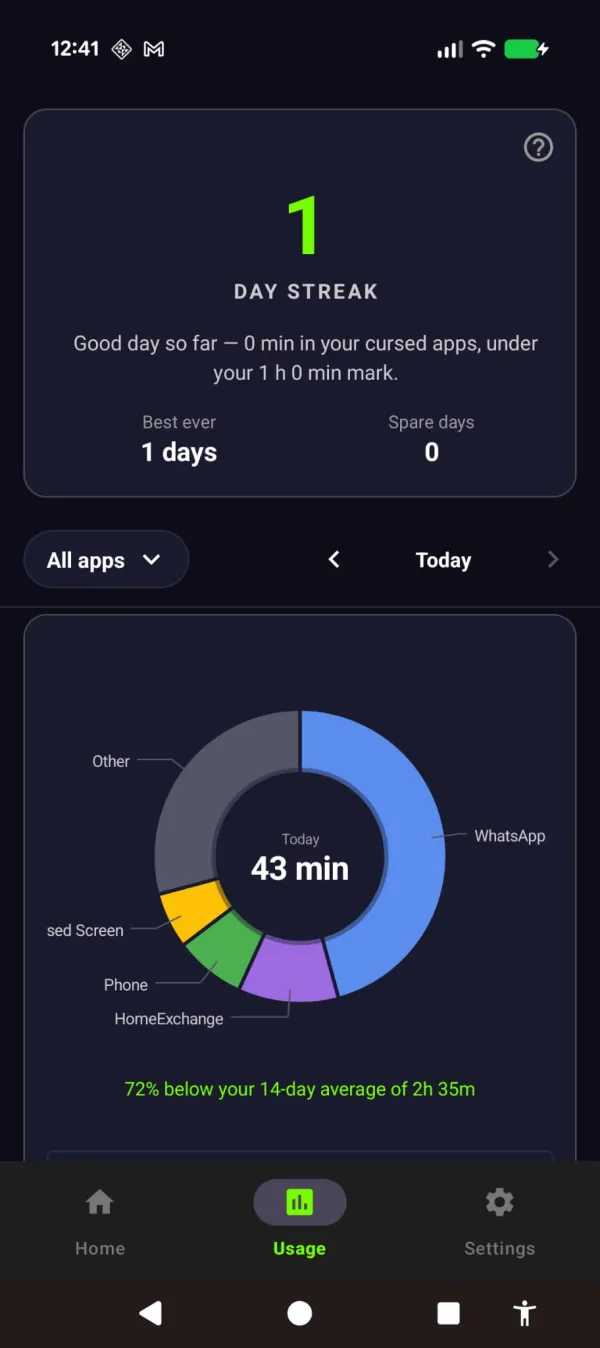
The other direction from the addiction loop: a streak that counts the days you stayed under, not the minutes you burned.
The screen time question you should actually ask
“How much screen time is too much?” is the wrong question. There’s no universal number. Two hours of FaceTiming your family is different from two hours of Reels.
The right question: “Am I using my phone, or is my phone using me?”
If you picked up your phone with a purpose, used it, and put it down, that’s phone use. If you picked it up to check one thing, blinked, and 40 minutes disappeared into content you didn’t choose, that’s your phone using you.
Most people’s screen time is a mix of both. The goal isn’t zero screen time. It’s less of the second kind.
Cursed Screen has a free trial on Android. It won’t count your minutes or lock your apps. It’ll just make your phone look like it’s falling apart when you’ve been on it too long. The useful stuff still works fine. The doomscrolling gets ugly. That’s the whole idea.
53% of Americans want to use their phone less. You’re one of them. The question is whether you’ll do something about it today, or read another article about it tomorrow. Don’t bother with a weekend dopamine detox — sustained reduction beats forced abstinence every time.
Reduce your screen time — without blocking anything
Cursed Screen makes your phone progressively uglier the longer you use it. No blocking, no willpower needed — you'll want to put it down.
Get Cursed Screen on Google Play