Social Media Addiction: The Science and What to Do
210 million people worldwide are estimated to be addicted to social media. Not “heavy users.” Not “frequent scrollers.” Addicted. Compulsive use despite negative consequences, inability to stop, withdrawal symptoms when access is removed.
You’re not part of some fringe group. You’re part of a global population that was targeted by the most sophisticated behavioral engineering ever built, and the engineering worked.
The scale of the problem
The numbers are hard to argue with.
The global average for social media use is 2 hours 41 minutes per day, up from 2 hours 35 minutes in 2024. That’s the average. Heavy users are at 4+ hours. 92% of social media consumption happens on mobile. Your phone is the primary delivery mechanism for the addiction.
By platform:
- TikTok users spend an average of 89 minutes per day on the app. 72% watch more than they intended in any given session. The full picture lives in our piece on TikTok addiction.
- Instagram Reels account for over 50% of time spent on Instagram. Not the feed, not Stories, not DMs. The short-form video tab that keeps you swiping. Reels-specific anatomy is in Instagram addiction.
- YouTube Shorts crossed 70 billion daily views in 2025.
- Reddit averages 34 minutes per visit. What feels like “5 minutes of reading” is usually half an hour.
50% of teenagers identify as addicted to their phones, with social media being the primary driver. 82% of college students believe they’re probably addicted. At some point, when 82% of a population reports the same behavior, calling it “addiction” stops being controversial and starts being descriptive.
What makes social media addictive
Social media addiction isn’t about weak willpower. It’s about design. Specifically, four design patterns that exploit your neurology.
Variable-ratio reinforcement. Not every post is interesting. Most aren’t. But every 5th or 10th one is genuinely funny, outrageous, or relevant. That unpredictability keeps you scrolling. If every post were equally good, you’d get bored and leave. If every post were bad, you’d leave immediately. The random spikes of reward are what lock you in. Same mechanism as slot machines.
Infinite scroll. No pages. No “next” button. No natural stopping point. The feed never ends. Your brain never gets the signal that says “this is done” because the content is never done. Aza Raskin, who invented infinite scroll in 2006, has publicly called it one of his biggest regrets.
Social validation loops. Likes, comments, shares, follow counts. Each notification is a micro-dose of social approval. Your brain processes social validation through the same reward circuits as food and physical affection. The platform learned this early and designed every notification to maximize that response.
Algorithmic personalization. The feed isn’t random. It’s a model of your preferences built from every swipe, pause, like, and share you’ve ever made. Within 30 minutes of using TikTok, the algorithm has a behavioral fingerprint of what keeps you watching. It gets better every session. You’re training the system to addict you more effectively every time you use it.
Fear of missing out (FOMO). Social media creates a persistent feeling that something interesting is happening right now that you’re not part of. Stories expire in 24 hours. Trends come and go in days. Group chats move fast. The cost of being offline isn’t just missing content — it’s missing context. When everyone at lunch references a meme you haven’t seen, you feel excluded. That exclusion drives you back to the feed.
These five patterns working together are why social media is harder to quit than most substances. The delivery mechanism is always in your pocket. The dose is infinite. The design evolves in real time. And the social layer makes quitting feel like social isolation. The behavioral end of this — doomscrolling — is the visible symptom; social media addiction is the diagnosis underneath.
What social media addiction does to you
A two-wave longitudinal study published in 2025 tracked the relationship between social media use and mental health over time. Doomscrolling was significantly associated with higher anxiety, depression, and stress. Not correlated in a snapshot. Tracked as a causal relationship over multiple time periods.
Mental health degrades. Young adults using phones 5+ hours daily show a 21% higher rate of depressive symptoms than those under 2 hours. U.S. mental health clinics reported a 16% rise in phone-related anxiety cases in early 2025 vs 2024. The relationship is dose-dependent: more social media, worse mental health outcomes, in a linear curve.
Sleep gets destroyed. Each additional hour of screen time before bed raises insomnia risk by 59%. The scroll at midnight isn’t just stealing time. It’s activating your reward system when your brain should be winding down for sleep. You’re not just staying up late. You’re chemically preventing sleep.
Attention span collapses. Short-form video recalibrates your dopamine baseline to expect new stimulation every 15 seconds. Anything slower — a book, a conversation, a work task requiring sustained focus — registers as boring. This isn’t laziness. It’s neurological adaptation to a stimulus pattern that nothing in your offline life can match. People are calling the cognitive endpoint of this brain rot, and the research is starting to back the slang up.
Relationships suffer. 51% of people in relationships report being phone-snubbed (phubbed) by their partner. 71% say they spend more time on their phone than with their romantic partner. Social media addiction is ironically antisocial: the more time you spend on apps designed for connection, the worse your real-world connections get.
Why quitting social media doesn’t work
“Just delete Instagram” is the “just eat less” of digital health. Technically correct. Practically useless.
64% of people have tried a social media detox. 49% came back. The relapse rate tells you everything about the cold-turkey approach. Deletion creates deprivation. Deprivation creates craving. Craving creates reinstallation, usually within days.
Social media also serves real functions. Group chats for organizing events. Marketplace for buying and selling. Messaging for people who don’t use SMS. Professional networking on LinkedIn. Quitting entirely means losing access to these, which is why most people don’t sustain it. The deeper issue is general phone addiction — even if you quit one platform, the device is still in your pocket.
The approaches that work don’t require quitting. They change the experience of using social media so that the compulsive part becomes less rewarding.
What the research says works
A 2025 randomized controlled trial found that three weeks of screen time reduction produced measurable improvements in well-being, depression, sleep quality, and stress. Reduction, not elimination. Sustained, not temporary. Three weeks, not a weekend.
Friction before opening. One Sec and ScreenZen add a pause before you open social media apps. A breathing exercise, a countdown, a moment of reflection. ScreenZen is free. One Sec is free for one app. Both reduce app opens by interrupting the autopilot. Limitations: friction fades over weeks, and they don’t do anything once you’re inside the app scrolling.
Blocking specific apps. AppBlock and Freedom prevent access to social media during scheduled times. Useful for work hours or bedtime. Strict mode prevents cheating during a session. Limitations: you control the blocker, so you can disable it. Block one platform and you migrate to another.
Visual deterrence. Cursed Screen doesn’t block social media or add friction before opening it. It makes your phone’s screen progressively ugly the longer you use it. After a grace period, visual overlays creep in. A red glow. Glass cracking. Insects on the screen. You can keep scrolling Instagram. You just won’t want to, because your feed is covered in crawling insects.
This handles the two biggest problems with blocking: there’s nothing to disable, and it works across all apps simultaneously. Switch from Instagram to TikTok to YouTube — the overlay follows because it tracks total screen time, not individual apps. And it works inside the app during a scroll session, not just at the door.
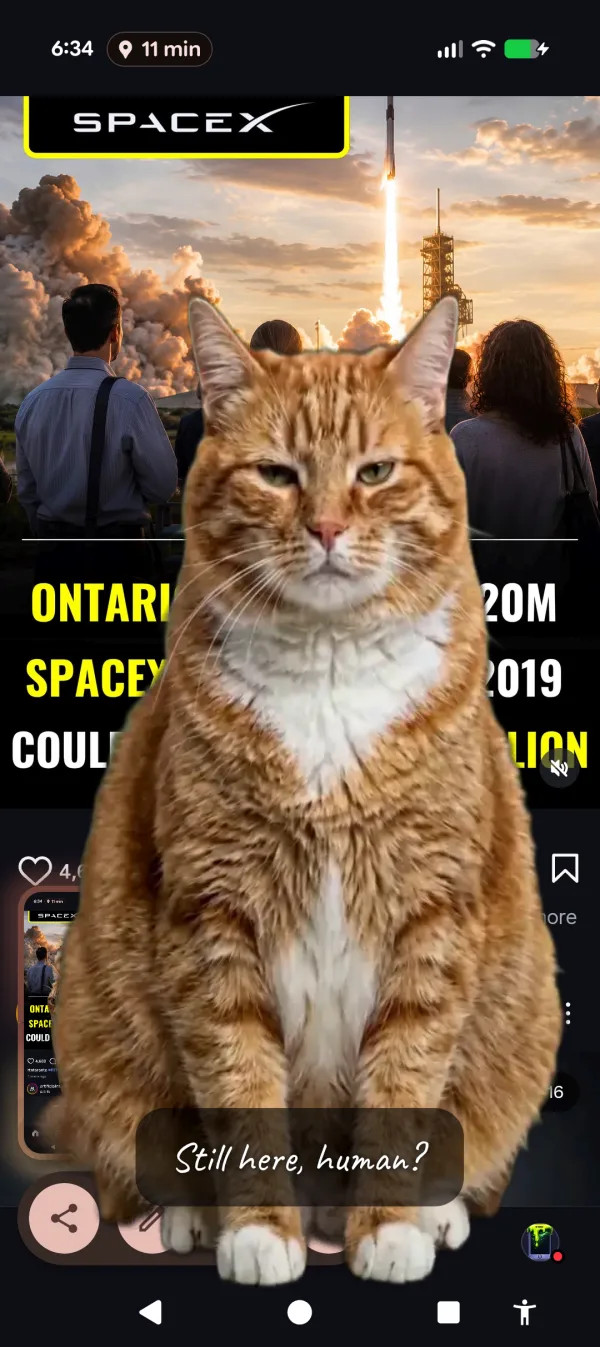
Switch apps all you want — the overlay follows your time, not the app. Here, a distinctly unimpressed cat.
For a social media break that doesn’t require deleting anything, the positive mode flashes aurora borealis and sunlight with messages like “someone is smiling nearby” and “the world misses you.” It turns social media sessions into interrupted sessions, where the interruption reminds you there’s a world beyond the feed.
Start here
You don’t need to quit social media. You need the scroll to stop feeling free.
Check your screen time tracker right now. Look at yesterday’s social media total. If that number surprises you, something needs to change. Not a detox. Not a deletion. A sustained change in how the scroll feels.
Cursed Screen has a free trial on Android. Subscribe monthly or annually, or pay once for lifetime access. Your social media still works. It just looks like the phone knows you’ve been on it too long.
210 million people are addicted to social media. The platforms won’t fix this. They profit from it. The fix has to come from your side of the screen. For specific tactics, read how to stop doomscrolling — the patterns transfer directly.
Reduce your screen time — without blocking anything
Cursed Screen makes your phone progressively uglier the longer you use it. No blocking, no willpower needed — you'll want to put it down.
Get Cursed Screen on Google Play