Screen Time and Mental Health: What Research Shows
Headlines say screen time causes depression. Social media companies say the research is inconclusive. The truth is somewhere in between, and the details matter if you’re trying to decide how seriously to take your own screen time.
Here’s what the research actually says, without the spin.
The dose-response relationship
The most consistent finding across studies: the relationship between screen time and mental health is dose-dependent. Low hours barely move the needle. Past a threshold, risk jumps. The threshold varies by age, but the pattern holds.
Teenagers: 1 in 4 teens with 4+ hours daily screen time experienced anxiety (27.1%) or depression (25.9%) in the past two weeks. For teens under 4 hours, those numbers are 12.3% and 9.5%. The risk roughly doubles past the 4-hour mark.
Young adults: Those using phones 5+ hours daily show a 21% higher rate of depressive symptoms compared to those under 2 hours. U.S. mental health clinics reported a 16% rise in phone-related anxiety cases in early 2025 vs 2024.
General population: A 2025 randomized controlled trial showed that reducing screen time for three weeks produced measurable improvements in well-being, depression, sleep quality, and stress. This is causal evidence, not just correlation. Reduce the input, the output improves.
What kind of screen time matters
Not all screen time is equal. The research increasingly distinguishes between passive consumption and active use.
Passive consumption — scrolling feeds, watching short-form video, browsing without purpose — correlates most strongly with negative mental health outcomes. This is the doomscrolling pattern: content chosen by an algorithm, consumed without intention, leaving you feeling worse than when you started.
Active use — messaging friends, video calls, creating content, intentional research — has a weaker or even positive correlation with mental health. Using your phone to connect with people is fundamentally different from using it to passively consume.
A longitudinal study on doomscrolling tracked this distinction over time. Doomscrolling specifically (not just general phone use) was significantly associated with higher anxiety, depression, and stress. The type of use matters more than the amount.
The sleep connection
Sleep is the strongest mediator between screen time and mental health. The path looks like this: more screen time → worse sleep → worse mental health.
Each additional hour of screen time before bed raises insomnia risk by 59%. Students sleep 24 minutes less per night for every extra hour of screen use. 67% of teenagers report late-night phone use has disrupted their sleep.
Sleep deprivation alone drives a chunk of the anxiety and depression associated with high screen time. Fix the sleep and some of the mental health impact resolves on its own, even without reducing daytime phone use.
This is why nighttime phone use matters disproportionately. An hour of TikTok at 2pm is different from an hour at midnight. The content is the same. The impact on your sleep architecture is not.
What the research doesn’t say
Screen time doesn’t “cause” depression in a simple sense. The relationship is bidirectional. People with depression use their phones more (as a coping mechanism). More phone use worsens depression. It’s a feedback loop, not a one-way causal chain.
Moderate screen time isn’t harmful for most people. The negative effects are concentrated at the high end (4+ hours for teens, 5+ hours for adults). Someone using their phone 2 hours a day with intentional, active use is probably fine.
Individual variation is massive. The same amount of screen time affects different people differently depending on what they’re watching, why they’re watching it, what they’re displacing, and their baseline mental health. Population-level statistics don’t predict individual outcomes perfectly.
What to do with this information
If your screen time is under 3 hours and mostly intentional, the research says you’re probably fine. Don’t let headline anxiety convince you otherwise.
If your screen time is 4+ hours with significant passive consumption (social media, short-form video), the research says there are measurable effects on your mood, sleep, and anxiety. The effects are reversible — three weeks of reduction is enough to see improvement.
Fix sleep first. No phone in the bedroom, or at minimum no phone after 10pm. The 59% insomnia risk increase per hour of bedtime screen use makes nighttime phone use the highest-impact target.
Shift passive to active. Replace scrolling with messaging. Replace feed consumption with intentional searches. The mental health impact is concentrated in passive use, so shifting the ratio helps even without reducing total time.
Reduce the passive portion. Friction apps (ScreenZen, free), environment changes (phone in another room), or visual deterrence (Cursed Screen) all target the compulsive, unintentional phone use that drives the worst outcomes.
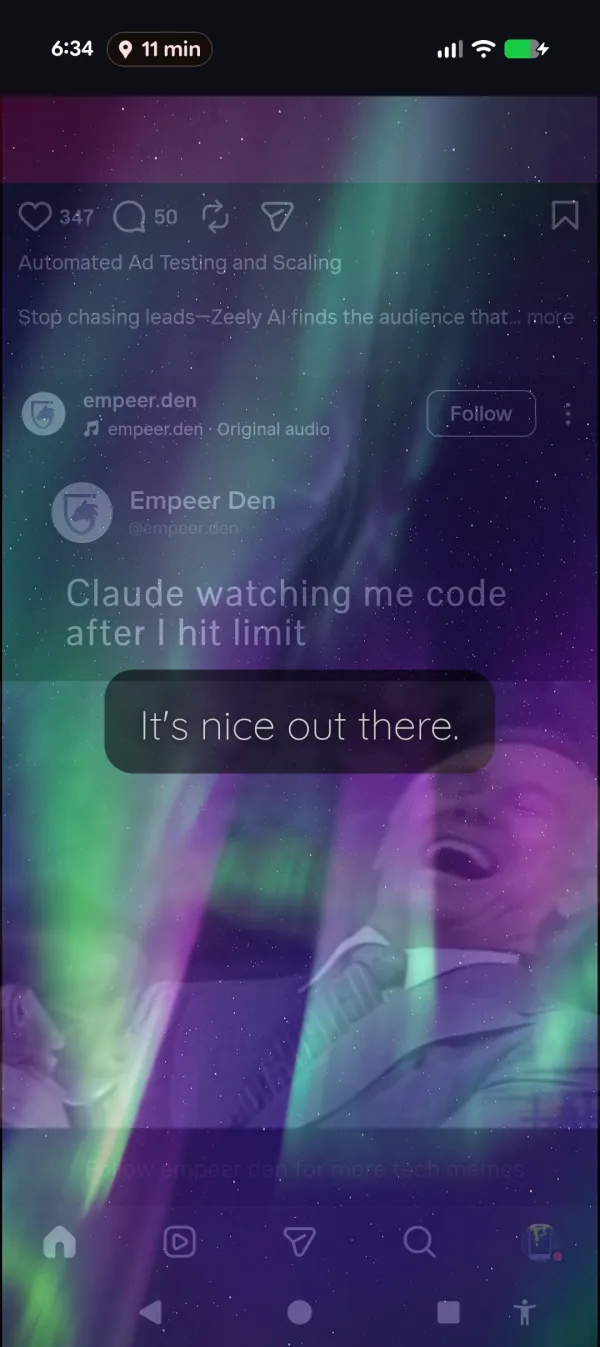
Cursed Screen specifically targets extended sessions — the passive consumption that the research links to mental health decline. A quick intentional check stays clean. A 60-minute scroll gets ugly. If you’re already low and a phone that turns uglier is the wrong lever, there’s a positive mode instead — brief flashes of aurora and sunlight with nudges toward what’s off the screen, so the pull comes from something hopeful rather than grim. Free trial on Android. Subscribe monthly or annually, or pay once for lifetime access.
If you’re already low, the gentler lever: brief flashes of aurora and a reminder of what’s off the screen.
If it’s heavier than a habit
If the scrolling sits on top of real depression, anxiety, or thoughts of harming yourself, no app can carry that — and you shouldn’t have to alone. A doctor or therapist helps in a way a screen effect can’t. If you’re in crisis, you can find a helpline for your country. Cursed Screen is a nudge toward putting the phone down, not a treatment for what’s underneath it.
The research is clear on one thing: less passive screen time improves mental health. How you get there is up to you.
Reduce your screen time — without blocking anything
Cursed Screen makes your phone progressively uglier the longer you use it. No blocking, no willpower needed — you'll want to put it down.
Get Cursed Screen on Google Play