Nomophobia: The Fear of Being Without Your Phone
Your phone is at 3%. You’re 20 minutes from home. No charger. Your chest tightens. Your hand keeps going to your pocket to check. You start calculating whether 3% will last if you don’t open anything. You know this reaction is irrational. You can’t stop it.
That’s nomophobia. And it’s not a quirky internet term. It’s a recognized psychological condition studied across hundreds of papers since 2008.
What nomophobia actually is
Nomophobia stands for “no mobile phone phobia.” It was coined by researchers at the UK Post Office during a 2008 study that found 53% of mobile phone users in Britain experienced anxiety when they lost their phone, ran out of battery, or had no signal.
The condition describes a disproportionate fear of being separated from your phone. Not mild annoyance. Genuine anxiety. Racing thoughts, restlessness, difficulty concentrating on anything else, physical symptoms like sweating or elevated heart rate. The same category of response as other situational phobias, triggered specifically by phonelessness. It’s the anxious flip side of phone addiction — same dependency, viewed from the absence rather than the presence.
It’s not in the DSM-5 yet, but researchers have proposed it, and it’s been studied in enough peer-reviewed journals that the clinical community takes it seriously. A 2025 study noted that smartphone dependency is now being examined through the same lens as behavioral addictions like gambling disorder.
12,100 people search for “nomophobia” every month. Most of them already suspect they have it.
Signs you might have it
Nomophobia isn’t about using your phone a lot. Plenty of people use their phone 5 hours a day without anxiety when they put it down. Nomophobia is specifically about the distress that comes from not having the phone. The signs:
You check your phone is still there even when it hasn’t buzzed. Pocket pat. Table glance. The phantom vibration you feel that wasn’t real. If you’re checking for the presence of your phone rather than for notifications, that’s nomophobia behavior.
Low battery causes genuine stress. Not “I should charge this” but an emotional response. Tightness. Urgency. Difficulty focusing on anything else until you find a charger. The battery percentage becomes a stress metric.
You can’t leave the house without your phone. You’ve gone back for it. You’ve been late because you went back for it. The thought of spending a full day without it — no phone at all — produces anxiety, not relief.
Being in a no-signal area feels threatening. Elevators, basements, rural areas, airplane mode. The moment your phone shows “no service,” something shifts. Even if you have no reason to need a connection right now.
You sleep with your phone within arm’s reach. Not on the nightstand. In the bed, or directly next to the pillow. The phone is the last thing you touch before sleep and the first thing you reach for in the morning, before your eyes are fully open.
Social situations without your phone feel exposed. Like you’re missing a layer of protection. The phone serves as an escape hatch from awkward moments, a buffer against boredom, a security blanket. Without it, social situations feel rawer.
49% of Americans feel they’re addicted to their devices. 58% of teens report anxiety when separated from their phones. If those numbers seem high, it’s because the condition is that common.
Why it happens
Nomophobia isn’t a character flaw. It’s a conditioned response.
Your phone has been paired with virtually every positive stimulus in your life for years. Social connection. Entertainment. Information. Safety. Navigation. Banking. Music. When your brain maps one object to that many rewards, losing access to that object triggers loss-aversion responses. The same neural machinery that protected your ancestors from losing food sources is now firing because your phone is at 2%.
The conditioning runs deep because the phone is always there. Unlike a laptop that stays at home or an office computer you leave at 5pm, the phone is in your pocket during every waking hour. It’s present during meals, conversations, commutes, workouts, bathroom breaks, and sleep. Your brain has more associative pairings with your phone than with almost any other object in your life.
Social media addiction amplifies the dependency. The phone isn’t just a tool; it’s the portal to your social world. Missing a text, a DM, a comment, a story update — these feel like missing a social event. The fear isn’t about the device. It’s about disconnection from people, expressed through disconnection from the device.
What doesn’t help
“Just leave your phone at home for a day.” Exposure therapy without preparation can worsen anxiety, not reduce it. For someone with genuine nomophobia, going cold turkey produces a stress response that reinforces the fear next time.
Screen time limits. These address how much you use the phone, not the anxiety you feel when it’s gone. You can hit your daily screen time limit and still panic when the battery dies. The usage and the dependency are related but separate.
Shaming. “It’s just a phone” is the equivalent of telling someone with a fear of heights “it’s just a building.” Nomophobia is a conditioned response. Rational arguments don’t decondition it.
What actually helps
The research on nomophobia treatment is still developing, but the principles that help other situational phobias apply:
Gradual exposure, not cold turkey. Leave your phone in a different room for 30 minutes. Then an hour. Then during a whole meal. Then during a whole evening. Build tolerance to phonelessness incrementally. Your nervous system adapts to the absence when the exposure is controlled and repeated.
Address the underlying anxiety. For many people, nomophobia sits on top of generalized anxiety. The phone is both a coping mechanism and a trigger. Treating the anxiety (through therapy, mindfulness, whatever works for you) reduces the grip the phone has as an emotional escape.
Reduce dependency gradually. This is where screen time tools enter the picture. Not to cure nomophobia directly, but to slowly weaken the association between “phone present” and “everything is fine.” Our full plan for how to break phone addiction walks through this layer by layer, and most of it transfers cleanly to nomophobia.
Cursed Screen works here in a way that blockers don’t. Blocking apps increases phone anxiety, because now the phone is present but restricted — which for someone with nomophobia can feel worse than not having the phone at all. Cursed Screen doesn’t block anything. The phone still works fully. It just gets visually ugly after extended use.
The effect is subtle but important: instead of the phone being a source of unlimited comfort (which feeds dependency), it becomes a source of limited comfort. The first 30 minutes feel normal. After that, the screen starts looking wrong. a red glow, cracking glass, insects. You can keep using it, but the comfort degrades. Over time, this weakens the association that the phone = safety, because the phone with an active overlay doesn’t feel safe anymore. It feels like you’ve been on it too long.
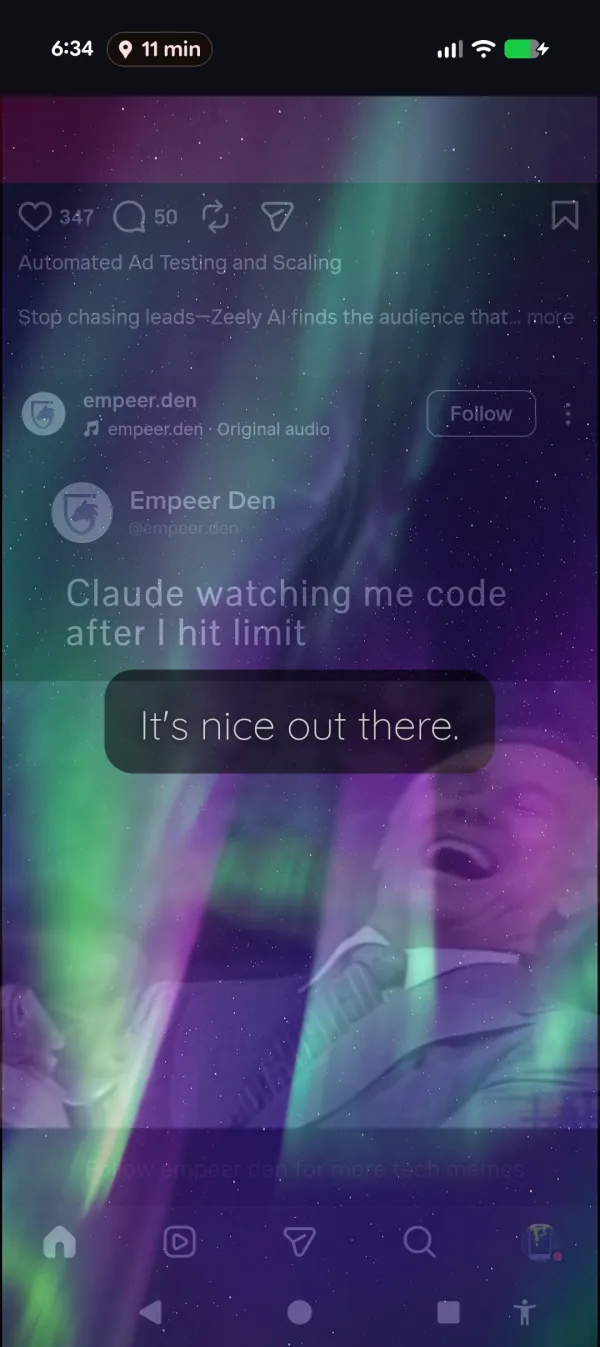
The positive mode serves a different function for nomophobic users. Flashes of aurora and sunlight with “the world misses you” and “there’s magic out there” remind you that the world outside the phone isn’t threatening. It’s beautiful. The phone’s grip loosens when the alternative stops feeling empty. The same shift helps with the slow attention decay people call brain rot — the world starts looking interesting again once the feed stops being the baseline.
The reverse of dread: flashes of aurora that say the world off the phone isn’t empty. It’s worth walking back into.
If the anxiety runs deeper than the phone
If the scrolling sits on top of real depression, anxiety, or thoughts of harming yourself, no app can carry that — and you shouldn’t have to alone. A doctor or therapist helps in a way a screen effect can’t. If you’re in crisis, you can find a helpline for your country. Cursed Screen is a nudge toward putting the phone down, not a treatment for what’s underneath it.
Cursed Screen has a free trial on Android. Subscribe monthly or annually, or pay once for lifetime access. It won’t cure nomophobia. But it’ll start weakening the association between your phone and comfort, which is where the dependency lives.
Your phone isn’t keeping you safe. It’s keeping you dependent. There’s a difference.
Reduce your screen time — without blocking anything
Cursed Screen makes your phone progressively uglier the longer you use it. No blocking, no willpower needed — you'll want to put it down.
Get Cursed Screen on Google Play