ADHD and Screen Time: The Vicious Cycle and How to Break It
ADHD and screen time feed each other. A 2024 cross-sectional study confirmed what clinicians already see in patients: ADHD traits predict smartphone overuse, and smartphone overuse worsens ADHD symptoms. More screen time makes your ADHD worse. Worse ADHD drives more screen time. The cycle tightens.
A review of 147 studies spanning January 2018 to December 2024 found that excessive and unstructured screen time is consistently associated with worsening ADHD symptoms, particularly inattention and hyperactivity. Sleep disruption and altered reward processing mediate the relationship.
If you have ADHD, your screen time isn’t just a time management problem. It’s a neurological feedback loop.
How the cycle works
ADHD brains run on lower baseline dopamine. Your brain constantly hunts stimulation. Before phones, you’d fidget, daydream, or start five projects. Now you reach for the most efficient dopamine source in human history — a phone delivering new content every 15 seconds.
Extended phone use floods that dopamine system. Your brain adjusts by raising the threshold for what feels stimulating, so activities that used to hold your attention (reading, conversation, work) register as boring. The inattention symptoms get worse because the baseline shifted.
Now the tasks ADHD already made difficult get harder after hours of short-form video. You need the phone more because everything else has become less tolerable. You use the phone more. Tolerance climbs again.
Sleep compounds the whole thing. Impulsivity is the strongest mediator between screen time and ADHD symptoms, and sleep deprivation is what cranks impulsivity up. Phone use disrupts sleep. Less sleep means more impulsive scrolling means even less sleep. A cycle inside the cycle.
What makes ADHD screen time different
The ADHD-screen time relationship isn’t just “more of the same” that everyone experiences. It’s qualitatively different.
Hyperfocus traps. Neurotypical people drift into scrolling. ADHD people lock into it. Hyperfocus — the ADHD state of intense, involuntary concentration on a stimulating activity — makes phone sessions longer and harder to interrupt than neurotypical sessions. You don’t notice time passing. An hour feels like ten minutes. Breaking the hyperfocus requires an external interrupt (alarm, partner, dead battery) because the internal interrupt (executive function) is offline.
Emotional regulation through the phone. ADHD impairs emotional regulation. The phone becomes a go-to coping mechanism. Frustrated? Phone. Bored? Phone. Anxious? Phone. Restless? Phone. The phone soothes every uncomfortable emotional state, which means you reach for it more frequently than a neurotypical person would. Reducing phone use means losing your primary emotional regulation tool.
Higher impulsivity. The impulse to pick up the phone fires before conscious thought intervenes. By the time the ADHD brain registers “I shouldn’t be on my phone,” the hand has already picked it up and the app has already opened. Interventions that require conscious decision-making (timers, limits, friction) fire after the impulse has already won.
Breaking the ADHD-screen time cycle
The standard screen time advice (set limits, use willpower, replace with healthier habits) fails harder for ADHD. See our full guide on how to focus with ADHD when your phone won’t let you.
The approaches that work for ADHD share one trait: they don’t rely on executive function.
Environment changes. Phone in a different room during focus time. Physical separation bypasses impulsivity because the phone isn’t within reach to grab. The impulse fires and fizzles.
Body doubling. Working alongside someone else borrows focus from the social context. The phone stays in the pocket because of social presence, not willpower.
Medication. ADHD medication raises baseline dopamine. When the deficit is treated, the phone’s pull weakens because the brain isn’t as desperate for stimulation. Talk to a psychiatrist. This one isn’t an app choice.
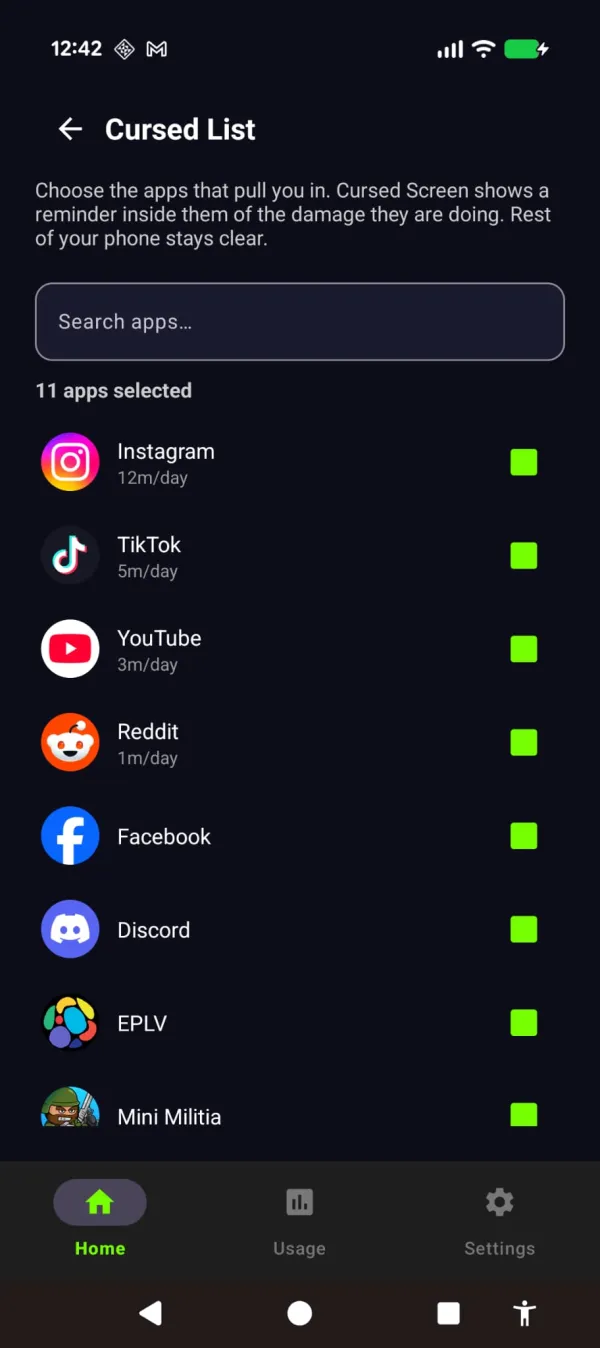
Visual deterrence. Cursed Screen doesn’t require executive function. The overlays (hellfire, bugs, glass cracking) register through sensory processing, which ADHD doesn’t impair. The phone becomes visually unpleasant automatically. No decision needed. The discomfort does the work that willpower can’t.
Point it at the apps that eat your day. Nothing needs blocking.
With session-based tracking, the phone adapts to ADHD’s burst-usage pattern. Short intense sessions followed by breaks aren’t penalized the way daily cumulative tracking would penalize them. The 3:1 decay means every three minutes off the phone forgives a minute of accumulated corruption.
The medication + tool combination
For many adults with ADHD, the most effective approach is medication plus environmental tools. Medication addresses the neurological deficit. Tools address the behavioral patterns that built up over years of unmedicated phone use.
Medication alone doesn’t automatically fix phone habits. You’ve built neural pathways for reaching for the phone under every emotional state. Those pathways persist after medication. The medication makes it possible to choose differently. The tools make the different choice easier.
Cursed Screen has a free trial on Android. For ADHD specifically: set session-based tracking, 5-minute grace period, intermittent flash mode, and a high-intensity theme. Free trial on Android. Subscribe monthly or annually, or pay once for lifetime access.
The cycle breaks when you change the input. Your ADHD isn’t going away. The phone’s design isn’t going to stop being addictive. What can change is how the phone feels after 30 minutes of use. Make it feel wrong, and the cycle has one fewer reinforcement.
Reduce your screen time — without blocking anything
Cursed Screen makes your phone progressively uglier the longer you use it. No blocking, no willpower needed — you'll want to put it down.
Get Cursed Screen on Google Play