Phubbing: The Phone Habit That's Destroying Your Relationships
You’re at dinner. Your partner is talking. You’re nodding at the right moments, but your eyes keep sliding to the phone on the table. They notice. They always notice. They don’t say anything anymore because they’ve said it before and nothing changed. That’s phone addiction playing out at the dinner table — the device wins because it doesn’t have to wait its turn.
That behavior has a name. Phubbing: phone snubbing. Using your phone while someone is trying to connect with you in person. And 51% of people in relationships report that their partner does it to them.
What phubbing actually is
The term was coined in 2012 by a marketing campaign — an Australian dictionary group crowdsourced a word for the experience of being ignored in favor of a phone. It stuck because the experience was universal. Since then, it’s been studied in over 52 academic papers and a 2025 meta-analysis synthesized data from nearly 20,000 participants.
Phubbing isn’t just “checking your phone.” It’s the chronic pattern of prioritizing the phone over the person in front of you. During meals. During conversations. During arguments. During sex. Every moment where presence matters, the phone wins.
71% of people report spending more time interacting with their phone than with their romantic partner. On average, people use their phone during 27% of the time they spend around their partner. 86% use their phone every single day around their partner. One in four relationships is directly affected.
What phubbing does to relationships
The research is clear and the effects are worse than most people assume.
Relationship satisfaction drops. The 2025 meta-analysis found that partner phubbing is significantly associated with lower relationship satisfaction, greater loneliness, and increased depression in the phubbee. The effect isn’t subtle. Being consistently ignored in favor of a screen erodes the foundation of connection. You stop feeling like a priority. You start feeling like an interruption.
Resentment builds. A daily diary study tracked couples over time and found that on days when partner phubbing was high, the phubbee reported greater anger, frustration, and resentment. More disturbing: they also reported greater retaliation — deliberately phubbing back. The phone war escalates. Both partners retreat further into their screens. The relationship gets quieter, not because things are peaceful, but because no one is trying to connect anymore.
Trust erodes. When your partner checks their phone mid-sentence, your brain registers it as a signal: what’s on that screen is more interesting than what I’m saying. Repeated over months and years, that signal calcifies into a belief. You stop sharing things. You stop starting conversations. You stop trying to compete with a device you can’t beat.
It predicts worse outcomes than most relationship issues. The same meta-analysis found that media addiction had the strongest correlation with phubbing — stronger than attachment style, depression, or loneliness. The phone isn’t a symptom of a bad relationship. For many couples, it’s the cause of the deterioration. Social media addiction is doing most of the work here — Instagram and TikTok don’t just steal your attention, they reroute it away from the person across the table.
Why “just put the phone down” doesn’t work
You’ve had the conversation. Maybe multiple times. “Can you put your phone down while we’re eating?” Your partner agrees. Puts it in their pocket. Three minutes later it’s back on the table. Five minutes after that they’re scrolling again. Not because they don’t care about you. Because the phone is designed to pull attention, and no amount of caring about your partner changes the neurological pull of variable-ratio reinforcement.
The problem isn’t motivation. Both partners usually agree that phones at dinner are bad. The problem is that the agreement is a conscious decision, and the phone pull is subconscious. Your conscious brain decides to be present. Your habitual brain reaches for the phone. The habitual brain wins because it doesn’t require energy or attention — it just acts.
Rules don’t survive this dynamic. “No phones at dinner” becomes “no phones at dinner except to check if the restaurant confirmed our reservation” becomes “let me just check this one thing” becomes scrolling. The exception eats the rule, every time.
What actually helps
Physical separation during connection time. Not “phone face down on the table.” Phone in a bag. Phone in the car. Phone in a different room. If the phone is within arm’s reach, the reach will happen. It needs to be physically inconvenient to check. This is the simplest intervention and the most effective for meals and conversations. The challenge: you both have to do it. One partner leaving their phone in the car while the other keeps theirs on the table creates a different kind of resentment.
A phone stack. Both partners put their phones in a stack when they sit down to eat. First person to grab their phone pays for dinner (or does the dishes, or whatever stakes work for you). Turns the phone into a social game instead of a solitary escape. Works surprisingly well because it adds a social cost to the habit.
Mutual visual deterrence. Both partners install Cursed Screen. The app makes your phone’s screen progressively ugly the longer you use it. flames, cracking glass, insects crawling from the edges. It doesn’t block anything. You can still use the phone. But when your partner glances over and sees your screen glowing red with creeping overlays, the conversation writes itself.
Or switch to the positive mode — a reminder of the person sitting right in front of you.
This works for couples specifically because it’s symmetrical. No one is the enforcer. No one is the rule-maker. Both phones get ugly at the same rate. If you pick up your phone during dinner, the overlay is visible to your partner — and that visibility is a more powerful deterrent than any rule. You don’t want your partner to see that your phone looks cursed. So you put it down.
Session-based tracking makes this even better for couples. Every minute you spend with the phone down reduces the overlay. Put the phone away for a 20-minute conversation and it’s nearly clean when you check it afterwards. The phone rewards you for being present. Your weekly screen time total drops too, but the immediate feedback is the part that changes behavior.
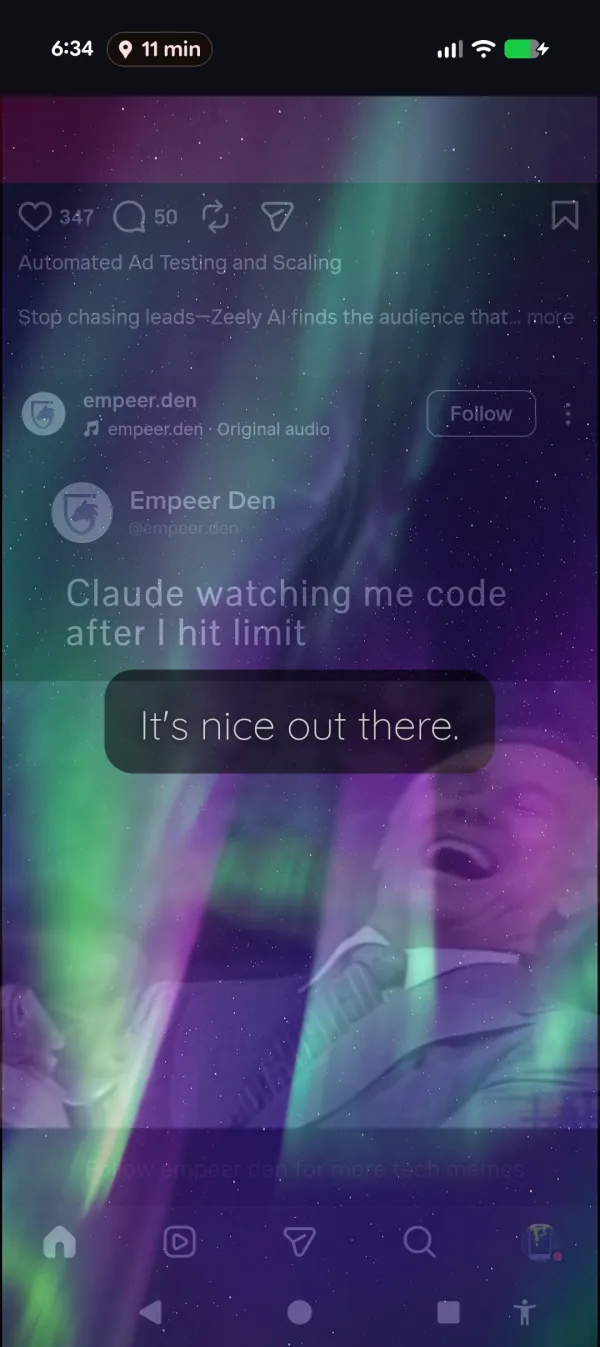
The positive mode works well here too. Flashes of aurora borealis and golden sunlight with “someone is smiling nearby” interrupting your scroll. When you’re sitting across from your partner and your phone tells you “someone is smiling nearby,” the irony does the work.
Therapy. If phubbing has been going on for years and resentment has built up, an app isn’t going to fix the damage already done. What it can do is change the dynamic going forward so the therapy has room to work. Couples therapy addresses the relationship. The app addresses the phone. Both need addressing.
The harder conversation
Phubbing is usually a symptom of something else. Boredom in the relationship. Avoidance of difficult conversations. Anxiety that the phone soothes. Loneliness within the relationship that social media temporarily fills.
The phone didn’t cause those things. But it makes them invisible. Instead of sitting with discomfort and addressing it, you scroll. Instead of saying “I’m bored” or “I’m unhappy” or “I need more from this relationship,” you open Instagram. The phone absorbs the tension without resolving it.
Putting the phone down means those feelings surface. That’s uncomfortable. It’s also the only way to actually deal with them. The longer practice of choosing presence over scroll is essentially digital minimalism at the couple level — you both decide which technology earns a seat at the table.
Cursed Screen has a free trial on Android. Install it on both phones. Subscribe monthly or annually, or pay once for lifetime access. No monitoring. No surveillance of your partner. Just two phones that get ugly when used too long, making it easier to choose the person across the table over the screen in your hand.
You didn’t fall in love with someone so you could sit across from them and scroll.
Reduce your screen time — without blocking anything
Cursed Screen makes your phone progressively uglier the longer you use it. No blocking, no willpower needed — you'll want to put it down.
Get Cursed Screen on Google Play