Gamified Phone Detox: Does Turning Quitting Into a Game Work?
Plant a virtual tree. Don’t touch your phone or the tree dies. Stay off long enough and you build a forest. Earn enough points and real trees get planted in Africa.
That’s Forest, the most popular gamified detox app. 10M+ downloads, 4.7 rating. The concept is clean: turn not-using-your-phone into a game with rewards, streaks, and visual progress.
Forest isn’t alone. emberglow sends an RPG hero on quests when you put your phone down. DoomScroll is a narrative game that aims to reduce scrolling through story. Opal uses scores, streaks, and “focus levels” to gamify screen time reduction.
The question: does turning your phone addiction into a game actually work?
Short answer: yes — but only when the game rewards the right thing and runs at the right time. Most phone detox game designs get one of those two wrong. Get both right and gamified screen time stops being a gimmick and starts being a habit.
Why gamification appeals
Gamification works by replacing one reward loop with another. Your phone gives you dopamine through social media. Forest gives you dopamine through tree-growing and streak-maintaining. The theory: swap the bad reward loop for a good one.
In the short term, it works. The game creates motivation. You protect your tree because killing it feels bad. You maintain your streak because breaking it feels bad. You check your Opal score because a high score feels good.
Forest’s success isn’t accidental. Guilt avoidance (don’t kill the tree) is a stronger motivator than aspiration (reduce your screen time). The game converts an abstract goal into a concrete, emotionally charged one.
What the game rewards decides everything
Here’s the split most people miss. A phone addiction game can reward two very different things, and they pull in opposite directions.
Rewarding app engagement. A lot of “wellness” gamification quietly rewards you for using the tracker. You open the app to check your focus score. You tap in to log a session. You come back to admire the streak. Opal users report checking their focus score constantly — the number becomes the thing. When the game rewards attention on the game, your total screen time doesn’t move. It just moves from TikTok to the tracker.
Rewarding less screen time. The other kind of game rewards the outcome you actually want: fewer minutes on the phone. The streak counts days you stayed under your limit. The leaderboard ranks who scrolled least, not who logged in most. You never have to open anything to win — the reward tracks your behavior in the background. This is the version that sticks, because the game and the goal point the same direction.
Forest sits closer to the good side: it rewards not-touching, not app-checking. That’s why it earned 10M downloads honestly. The trap is subtler ones where the score itself becomes the scroll.
The opt-in gap
There’s a second thing that decides whether a gamified detox works: when it runs.
Forest runs during active timer sessions you start manually. emberglow sends the hero out when you commit to a quest. These are opt-in by design. The 3 hours of unstructured phone use between sessions are unprotected. You build a beautiful forest during study blocks and scroll for 4 hours the rest of the day.
This isn’t a knock on the game. It’s a knock on the timing. The moments you most need help — the 11pm bed scroll, the autopilot TikTok open, the post-work binge — are exactly the moments you won’t stop to start a focus session. A game you have to remember to launch can’t reach the hours you lose without deciding to.
So the two questions stack: does the game reward less screen time, and does it run without you starting it? Get both right and gamification works. Miss either and it’s a nice month-one novelty.
What that looks like done right
Cursed Screen runs both plays at once.
First, the deterrent is automatic. After a grace period, visual overlays fill the screen — cracking glass, a crimson glow, crawling insects. No session to start. It doesn’t care whether you’re “focusing.” The 11pm scroll gets ugly. The autopilot TikTok open at a red light gets ugly. The post-work binge gets ugly. The phone looks wrong when you’ve been on it too long, and normal when you haven’t.
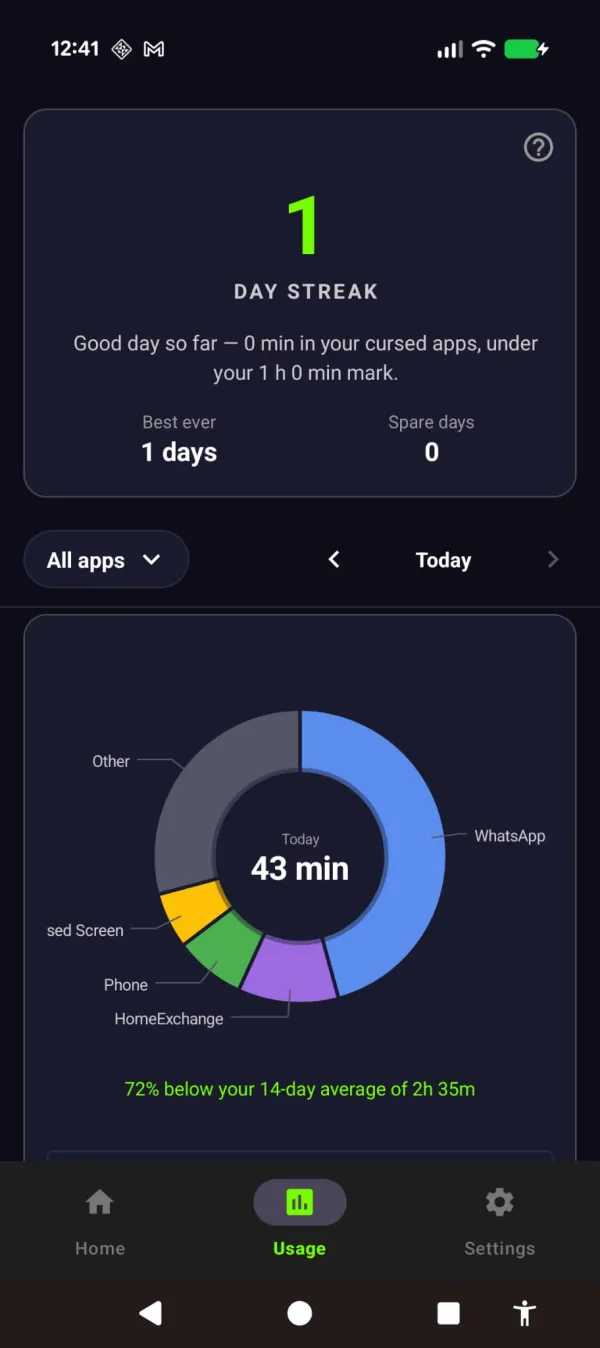
Second, the game rewards the outcome, not the app. There’s a streak — but it counts the days you kept your phone down, not the days you opened Cursed Screen. Stay under your limit and the number climbs while you’re doing something else entirely. Leaderboards are coming, and they rank the same way: least screen time wins, not most check-ins. Nothing to grind. Nothing to compulsively open. The reward reads your behavior and moves on its own.
The streak counts the days you stayed off — not the days you opened the app.
That’s the difference from the Forest app or Opal. Same idea — turn putting the phone down into a game you want to win — pointed at reducing screen time instead of engagement, and running all day instead of only during the sessions you remember to start.
When a session-based game is still the right tool
Opt-in gamification works for structured focus time with a clear start and end. Study sessions. Work blocks. “I need to focus for the next 90 minutes.” Forest and Pomodoro timers handle this well. The game adds motivation to a decision you’ve already made.
It struggles with unstructured daily phone use — the times you reach for your phone without a plan, when no session is running, when you need help most.
If your phone problem is limited to focus sessions, a session-based app is a fine fit. If your phone problem is the other 14 hours, you need a game that scores you automatically and a deterrent that runs without you starting it.
Cursed Screen has a free trial on Android. Subscribe monthly or annually, or pay once for lifetime access. The streak rewards the days you stayed off. The overlay handles the days you don’t. The game is simple, and it’s the right game: put it down, and watch the number climb.
Reduce your screen time — without blocking anything
Cursed Screen makes your phone progressively uglier the longer you use it. No blocking, no willpower needed — you'll want to put it down.
Get Cursed Screen on Google Play